
Nieman Foundation at Harvard

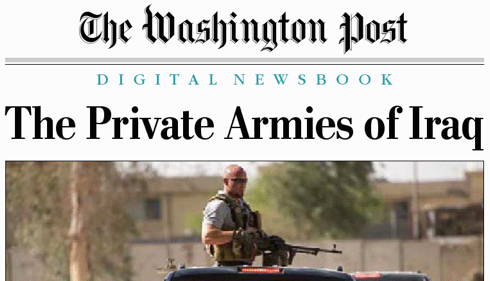
At more than 24,000 words, Steve Fainaru’s Pulitzer-winning reports on American mercenaries in Iraq were nearly as long as Heart of Darkness and just as eerie. But spread over nine installments in nine months, the Washington Post series could hardly be read as literature.
Later this month, a coalition of news organizations — including the Post, Los Angeles Times, and Memphis Commercial Appeal — will try selling some of their multipart series as repackaged “digital newsbooks” for e-reader devices. Fainaru’s series, “The Private Armies of Iraq,” will be among those available for $4.95.
It’s a small but intriguing attempt to monetize the most costly and least profitable work in a newsroom: investigative journalism. The Reynolds Journalism Institute at the University of Missouri is producing the newsbooks and coordinating their sale through two retailers, eReader Outfitters and MBS Direct. The latter targets educators, who Reynolds is hoping might use newsbooks in their courses.
“The newsbook is really an experiement to find out if people are willing to pay for a more convenient package of information,” Roger Fidler, who’s leading the initiative for Reynolds, told me in an interview. “And I believe they will. If you’ve tried reading a long series of content on the web for free, it’s not really enjoyable. What you’ll be paying for here is convenience and comfort.”
You can get a good sense of what newsbooks entail by browsing this prototype for a series in the Las Vegas Review-Journal, and there’s more information about the Digital Newsbook Publishing Project at its website.
I’m intrigued by the initiative because there are countless newspaper series that I’ve missed but always meant to catch up on. Or take that 19-part series in The New York Times deconstructing various causes of the financial crisis. I liked what I read but pouring through the rest would require the same commitment as curling up with a good book. And I agree with Fidler that lengthy articles aren’t — yet, at least — easy to read on a computer screen.
More than 30 news organizations are involved with the Digital Publishing Alliance at Reynolds, though not all of them are releasing newsbooks. They’re paying from $1000 to $3000 a year for membership, which is the only upfront cost. The price for non-profit organizations is $500 a year. Our sister publication, Nieman Reports, is a member and will soon release two newsbooks with content from the magazine, one focusing on digital journalism and the other on non-profit models for news. A third is in the works. “They are designed to offer journalism professors an up-to-date classroom resource to use as curriculum with their students,” editor Melissa Ludtke told me in an email.
News organizations will take 40 percent of the revenue from sales of their newsbooks, with another 40 percent going to the retailer and 20 percent to Reynolds. “It’s not going to make a huge amount of money,” Fidler told me at the start of our conversation. “The expectation is that it’s a long-tail type of strategy.” That is, any substantial revenue will be cumulative over the long term.
The project will face a few obvious roadblocks. Newsbooks won’t initially be accessible on the two most-popular e-readers, the Amazon Kindle and Sony Reader, because their screens are too small. In fact, newsbooks are just PDFs that you can view on a laptop or more obscure e-reader, which takes a lot of charm out of the project. Fidler said he’s working on later versions that would work on the Kindle, iPhone, and other devices.
There’s also the matter of charging five dollars for content that’s largely available for free on the news organizations’ own websites. I think some people will shell out for the convenience, but the market will undoubtedly be small. It could, however, augur a shift to charging for in-depth, enterprise reporting.
But that Washington Post series on mercenaries in Iraq? As with a lot of big investigative projects, Fainaru has already turned turned his reporting into a full-fledged book, available on the Kindle for $14.30. Whether anyone will pay for a cheaper collection of the original news articles remains to be seen.
UPDATE, April 10, 2009, 5:47 p.m.: The Wall Street Journal and Associated Press are members of the Digital Publishing Alliance at Reynolds, but they aren’t releasing newsbooks. I’ve updated the second and seventh grafs to reflect that information.