Twitter  Good morning! With the Tumblr deal now official, Yahoo promises "not to screw it up." nie.mn/114B798  
Nieman Journalism Lab
Pushing to the future of journalism — A project of the Nieman Foundation at Harvard

Niche outlets replace newspapers in Washington

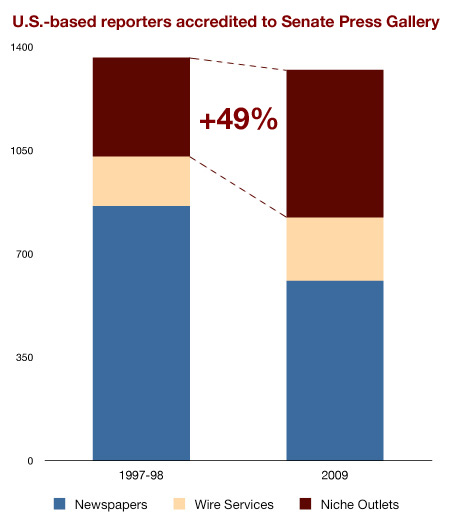
The next time someone tells you that the news industry’s financial crisis is hurting coverage of the federal government, point them to this chart. The Project for Excellence in Journalism has released new figures on the Capitol Hill press corps, and they show that Washington is still teeming with hacks. They’re just working for new types of organizations.

American newspaper reporters accredited to the Senate Press Gallery have declined 30 percent since the 1997-98 session, but the total number of U.S.-based reporters has remained steady (from 1,362 to 1,319). That’s because reporters from niche news outlets — think Politico, Roll Call, political magazines, and endless industry newsletters — have increased a stunning 49 percent (from 335 to 500). Many of these publications have found lucrative revenue streams in print advertisements by lobbying firms and other advocacy groups that want to reach the DC audience. (And these totals don’t count the many bloggers and other journalists who follow events in Washington closely without ever applying for a Senate press pass.)

Anecdotal evidence suggests that the trend will continue. Talking Points Memo is preparing to open a Washington bureau, and The Huffington Post is ramping up in the capital as well. Coverage of local government is another story, but looking at this chart, which I created with PEJ’s data, I feel comfortable that political reporting in DC is sufficiently staffed.


                                   
What to read next
AP Phone Records Subpoena
Mark Coddington    May 17, 2013
Plus: New developments in online video, The New Yorker’s Strongbox leak submission system, and the rest of the week’s future-of-news news.
  • http://poynter.org Jim Naughton

    Neither the chart nor the PEJ summary demonstrates, by itself, robust coverage of the federal government. It would be useful to know the identities of the “niche” journalists, their media outlets and their audiences. Sorry, but I’m not comforted by the chart.

  • http://newsafternewspapers.blogspot.com/ Martin Langeveld

    It would be interesting to see this same analysis for the White House press corps and other measurable entities.

    As Jim says we don’t know who the niche contingent is, or whether they are as full-time as the newspaper types they’ve replaced. On the other hand, the departed newspaper reporters probably worked for single markets or small groups while the niche sites tend to be online and broadly accessible (as is the reporting from the remaining print reporters) — so arguably there is more coverage available to more people than there ever was.

  • Zachary M. Seward

    There is certainly lots of crucial information not captured in this chart, and I don’t mean to suggest that this data is anywhere near sufficient to make a conclusion about the robustness of Washington news coverage. But I do think it’s a good retort to those who claim that just because newspapers have vacated DC, the federal government isn’t getting covered. In any event, PEJ has more in its February report about the news organizations that comprise the “niche” category, which is just their term for “other.”

    Another interesting datapoint from PEJ is that Washington-based foreign correspondents have increased from ~800 in 1994 to 1,490 in 2008. —Zach

  • Pingback: Dobra wiadomość dla dziennikarzy, zła dla nowych pseudo mediów « Brzytwą po oczach

  • Pingback: Senate Press Corps « Media & Politics in the United States

  • Pingback: Web and Tech Links: 22 July 2009