This week in review: Facebook’s future and the open web, and finding balance on breaking news nie.mn/yrRbkW
SHARE
Nieman Journalism Lab
Pushing to the future of journalism — A project of the Nieman Foundation at Harvard

Hearst, MediaNews: You can invent the future in San Francisco

MEMO TO: Steven Swartz (CEO, Hearst Newspapers) and Dean Singleton (CEO, MediaNews Group)
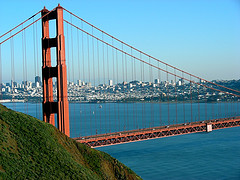
See that bridge?  When finished in 1937, it was not an incremental step.  It was a leap into the future.

Wouldn’t it be a terrific idea to search for the boldest, most imaginative solution to your problems in California?

Mr. Swartz, you’ve let it be known that Hearst will shut down the 339,000-circulation San Francisco Chronicle unless it is able to sell the paper or extract major concessions from its unions.  Mr. Singleton, MediaNews owns just about every daily paper surrounding San Francisco, but  revenue declines have forced you to impose mandatory furloughs on employees.

As Alan Mutter, the Newsosaur, suggests as part of a detailed analysis of the situation, and has suggested previously as well, MediaNews could be part of the solution.  Antitrust issues are unlikely to get in the way of a combination of some kind.  Major staff cuts are simply inevitable.  But there is an opportunity to go far beyond a simple consolidation of operations.

I’ve suggested this before but, you might have missed it.  So I’m going to repeat myself somewhat.

Mr. Swartz and Mr. Singleton, the real opportunity for Hearst and MediaNews in the Bay Area is to plan now for a truly transformational step toward the news enterprise of the future, rather than another incremental set of staff cuts and tonnage reductions on the path to oblivion.

It’s time to reinvent, to define a whole new way of doing business. In the Bay Area, that does mean merging the MediaNews papers and the Chronicle into one regional operation, but not stopping there.

Start by focusing on your Sunday editions, which are profitable, but could become much more profitable. The merged entity should cut print back to one big, highly profitable weekend package, distributed everywhere starting Friday afternoon rather than on Sunday.

The Weekend Chronicle (or pick a neutral title, like Bay Observer), would be bigger, better, more thoroughly read and more valuable to advertisers than all the current separate versions your two companies are publishing. They should drop all breaking news and focus on analysis and features. Their biggest value to readers would be as a guide to all other media.

Newspapers, especially on Sunday, have always served this “media guide” function, but haven’t effectively constructed themselves around it. Guide functionality is currently manifested in Sunday paper TV listings and reviews, book sections, movie sections, travel sections, arts sections, food and wine, fashion, real estate, home style or “living” and the like. (For some strange reason, few papers have done much to become guides to the internet, but that should be added to the mix.)

And yet this whole package is sold as a “news” paper, in a package wrapped with a breaking news section. This may have made sense until a decade ago, but it doesn’t any more. And unless it’s changed, the danger is that Sunday editions will start losing money also, eliminating any hope of returning to profitability.

Mr. Swartz and Mr. Singleton, let’s do this:  Take the camouflage off the Sunday package. Lose the hard news wrap.

Build up the “guide to all media” functionality — that’s the part subscribers are paying for, because they want and need it. Keep arts, travel, books, movies and all the rest. Add technology, internet and even magazine coverage. Include some geographically zoned sections if ad demand warrants it. Build other weekly, monthly or seasonal niche publications using the enterprise’s wealth of content.

Shift publication to the start of the weekend — Friday afternoon — to maximize the value to readers as well as newsstand shelf life (this edition would sell all week long).  Eliminate the current Saturday and Sunday editions.

Now, here’s the second big, bold step to consider:  Drop all other daily editions. Perhaps not immediately, but soon. Concentrate your sales efforts on moving the bulk of the week’s advertisers into the weekend edition — there’s still plenty of advertising that wants and needs to be in print, and this will make the weekend edition hugely profitable.  Take this step rather than considering incremental elimination of one day a week, then another, until there is nothing left.  If you move directly and completely to digital delivery of news, your audience will follow, especially in the Bay Area.

Devote about 20 percent of staff resources to the weekend product (and a fleet of niche spin-offs) and turn everyone else into online multi-media reporters in a truly online-first constellation of newsrooms.

Attract social networks around content areas. This is critical—in a sense, newspapers have always served as community social network hubs; they need to do so online.

Get the online sector ready for a big jump in mobile e-readership as new devices and apps catch on.  Offer a Bay Area daily on Kindle.

Forge alliances with TV and radio in the region — once-weekly publication allows you to ignore the FCC’s cross-ownership rule.

Differentiate the online site from the weekend print brand; they’re two different animals from now on.  But cross-promote every chance you get.

Outsource all your industrial functions and distribution; sell your buildings; become a truly digital enterprise.

Shrink the size of the business, but return to profitability.

Mr. Singleton, your firm is part of the reconfiguration of the publishing schedule in Detroit — you showed appetite for a bold step (home delivered editions on just three days) in that market, although I wish you had taken it further.  Now you have the chance to do that in California.

Mr. Swartz, in Seattle, you’ve signalled your intent to kill off the print edition of the Post-Intelligencer, while hinting that it may continue to operate an online-only P-I.  If it follows through with that, Hearst will be launching a laudable, imaginative experiment pitting a fully digital news enterprise against its former JOA partner, the Seattle Times.  With a bit of luck, you’ll break even in Seattle.

But in San Francisco, both Hearst and MediaNews need an even bigger, bolder vision and one that can make money, not just break even.  Hearst’s newspaper division is in the middle of “100 days of change.” It’s hard to see the point of eliminating nearly half the Chronicle’s staff just to stay afloat — here’s hoping that “change” might include consideration of some truly game-changing ideas.

Photo by http2007, used under Creative Commons Attribution License.

                                   
What to read next
knightKF
Justin Ellis    February 9, 2012
The Knight Foundation is opening up its contest by changing its rules and shortening the gestation period for ideas.
  • Uncle Sam

    Ever heard of the DOJ?

    How about Clint Reilly?

  • Pingback: Bollywood and hollywood - Movie reviews, News, gossip » Hearst, MediaNews: You can invent the future in San Francisco

  • http://newsafternewspapers.blogspot.com/ Martin Langeveld

    Uncle Sam:
    As I mentioned in the post, and as Alan Mutter says as well, the antitrust regulators are not likely to get too exercised over this kind of merger of entities in distress. Especially not when Google, all by itself, is likely to overtake the entire newspaper industry in total revenue in a year or two. See Mutter regarding Clint Reilly, as well.

  • http://virtualjournalist.wordpress.com Anthony Salveggi

    Martin, don’t you think there would still be a significant market for an free, scaled back evening daily tabloid in the Bay area? It seems to me that such a publication would be able to include the day’s most important stories for people who prefer to receive their news via print while also including a nightlife guide for those out on the town. And you could also point to the most important or hottest stories running on the Web. I realize that the weekly version you propose would have a number of small, easily portable guides, but it seems a waste not to also accommodate those who want instant access to print information wherever they are in the city.

  • Pingback: How to save the San Francisco Chronicle « Virtualjournalist

  • http://sellingprint.blogspot.com MichaelJ

    Martin,

    Exactly! The game changer is “They should drop all breaking news and focus on analysis and features.” From that everything else follows. What you propose all makes good sense, but I have a question.

    Do you have any thoughts about the viability of a daily edition, that might look like:

    12 to 24 page tabloid that sells for $.25

    (Charging something is the only way to get news stand distribution and to get a clear signal to supply the feedback to the publisher on the content.)

    Page 1: a summary of the latest buzz – “the breaking news” similar to the News In Brief the WSJ runs on the front page. Global, National, Regional, Local. One column for each.

    Page 2 &3: Five part feature story. Pt 1 on Monday,Pt 2 on Tuesday, etc Full five part available to read online on Monday.
    Also offered as to download to a Kindle for $2.00 and available as a reprint in paperback form using Print On Demand technology for $4.50.

    Page 4: Heard around the local web.
    Given that almost every community now has a good number of local conversations, the content is there. This would be “he said, she said” and “if you want to add your two cents, here’s the URL”

    The rest of the 12 -24 pages would be local ads, at low enough prices that local business could afford. With a frictionless sales process.

    The daily tab could be printed in versioned editions, different neighborhoods getting different news in briefs. Local would be neighborhood local. Or beat local as resources allow.

  • http://newsafternewspapers.blogspot.com/ Martin Langeveld

    Anthony:
    I agree that there’s room for a free daily if the standard home delivered print editions are eliminated. I’ve suggested that in previous posts (at my old blog newsafternewspapers.blogspot.com) and should have thrown it in the mix here. Probably it should be multiple free papers for the various parts of the region. All that could be figured out as part of the second phase after consolidating into the weekend edition.

  • http://newsafternewspapers.blogspot.com/ Martin Langeveld

    And Michael,
    Yes, same response as to Anthony. Could be free, could be $.25, published Mon-Fri. In reality it’s a niche publication which constitutes a totally different read from the weekend paper.

  • http://sellingprint.blogspot.com MichaelJ

    Thank you for the response. Always nice to feel one is not merely drinking one own’s Kool-Aid.

  • http://scoopingthenews.blogspot.com Chas J. Hartman

    Maybe the Chronicle should have followed the advice of this former SPJ national president:

    http://scoopingthenews.blogspot.com/2009/02/former-spj-president-cites-facebook.html

  • Pingback: One Big BANG: One Guild Universe

  • Rudolph

    Martin:

    Hearst is inventing the future, and one better than the one you describe.

    http://money.cnn.com/2009/02/27/technology/copeland_hearst.fortune/index.htm

  • http://sellingprint.blogspot.com MichaelJ

    Rudolph,

    Wow! Thanks for the point.

    I just got my first Kindle. Short story is that in three days, it’s completely changed my intense reading habit.

    If the next stage of the discussion is framed as how does Paper fit in with the Hearst device it should be a very productive conversation.

    If it creates another buzz about the end of this or the replacement of that, it will just keep going round and round.

    Here’s an opener for Print and News-on-epaper.

    News-on-Paper is the best search platform for viewers and scanners. The stability and large field of vision is best for pattern recognition. It’s the best way to notice new information or anomalies.

    News-on-ePaper may turn out to be the best way to read if you know what you want to read.

    The opportunity for news-on-Paper is that readers are a niche market while viewers and scanners are a mass market.

  • http://newsafternewspapers.blogspot.com/ Martin Langeveld

    Thanks Rudolph & Michael. The Hearst announcement is a pretty major development, I think. It shows that Hearst has cash and flexibility left to make strategic moves, a capability that is pretty scarce anywhere else in the industry.

    Michael, I have to quibble with your assertion that paper is “the best way to notice new information or anomalies.” Perhaps that’s so if you are a big consumer of paper, but I find more content about more topics of interest to me today online than I ever did before in print, despite the limitations of online navigation’s ability to show me material on spec, as it were.

    The challenge for both News-on-ePaper and news on other digital devices from computers to phones is to find a way to replicate on a digital screen the semi-directed serendipity that’s inherent in the act of scanning print.

    That means finding a replacement for search as the principal navigational tool on the digital side. For example, imagine the ubiquitous search field on web sites being joined by a “show me more” field driven by an engine that uses semantic techniques to act on knowledge of the reader’s preferences and viewing history do offer promise in this area. Put that on an e-reader, and you’re a lot closer to duplicating the paper-scanning experience — in fact, it could be an improvement over paper.

  • http://sellingprint.blogspot.com MichaelJ

    Martin,
    We agree that finding a new way to search is at the leading edge of the research of very smart highly incented people.

    But, it’s going to take a while. And there are some inherent problems with the media. The first is the size and cost. While Hearst is introducing the 8 1/2 by 11 format. That is not even in the right scale of a double page spread in tabloid, much less a broadsheet.

    My bet is that you, like me, are very focused in what goes into the “interesting” vs the “not interesting right now” bin. For “people like us,” Kindles, RSS readers, Google search is a revelation.

    But, no doubt “people like us” are a very small niche market. We have well practiced reading and thinking skills. In addition we have a strong focused interest that we can satisfy by using those hard earned skills.

    To be clear, the mass market is a collection of niches, or better tribes, with different focii and various levels of reading and thinking practice.

    The opportunity of news-on-paper is to be the search platform for that “mass market”. Put nuggets of unexpected information on the table, and allow people to choose what they would like to taste.

  • Rudolph

    I want to add that I think this is a very smart piece, as are the other pieces Martin has written for this site.

    And I can’t resist throwing out an idea:

    Wonder if newspapers could begin to transition their home delivery audiences into e-reader audiences?

    Could they afford to “buy out” the existing home delivery subscriber by giving her an e-reader bundled with a subscription for free?

    And then going forward, instead of selling new home delivery subscriptions sell e-readers bundled with subscriptions?

    Would that be better than what Detroit did by eliminating home delivery on certain days?

  • http://www.niemanlab.org Martin Langeveld

    Rudolph, yes, that idea gets mentioned from time to time, and must get puzzled over in the halls of Amazon, as well. It could be packaged in various ways. For example, buy a Kindle at full price, $359, get a one-year newspaper subscription on Kindle as part of the deal (versus renewing your print subscription for $150 or more). Amazon could kick back some amount to the newspaper in exchange for heavy print promotion. I would not be surprised to see the NYTimes start doing this, because at well over 10,000 Kindle subs during what was essentially Kindle beta, they must be seeing potential of 100,000 with Kindle 2.0.

  • http://sellingprint.blogspot.com MichaelJ

    The thing is the Kindle 2.0 is perfectly designed to read long form collections of words. books, essays, etc.

    If I read it correctly, the Hearst ereader is being designed for publications. 8 1/2 by 11, place for ads, foldable? and probably a lot less than $359.

    “What Hearst and its partners plan to do is sell the e-readers to publishers and to take a cut of the revenue derived from selling magazines and newspapers on these devices. The company will, however, leave it to the publishers to develop their own branding and payment models.”

    But why replace paper with epaper when the most profitable advertisements are those on paper?

    More likely it will be both. The New Yorker, for example gives full access to their archives to their Print subscribers. They don’t “sell” access, they “give it” as a benefit.

  • Pingback: Hearst’s 100 days: on the right track, or misguided? » Nieman Journalism Lab » Pushing to the Future of Journalism

  • Pingback: Footprints (19.03.09) | Chris Deary