
80 percent of newspapers gone in 18 months? Not likely.

By Martin LangeveldApril 21, 2009  /  9:38 a.m.

wolff2The soundbite that will circulate in the journoblogosphere for the next 24 hours, from columnist and Newser founder Michael Wolff on a panel discussion with Craig Newmark and Bennett Zier:

About 18 months from now, 80 percent of newspapers will be gone. The Washington Post is supported by Kaplan’s testing business. The testing business will still be around in 18 months, and they will probably continue to support the newspaper. But that’ll be an exception.

Now, I have a bunch of predictions hanging out there myself — some have come true already, some have already turned out to be off the mark, the rest are wait-and-see — but this one is a real doozy.  There are still about 1,430  daily papers in the U.S., so what Wolff’s prediction means that we can expect the extinction of 1,144 of them.  Which works out to, let’s see, a little over two per day, every day, for 18 months.  Sorry, that’s not happening.

To be sure, the industry is in deep, deep trouble.  Most of the top 10 or 15 newspaper owners are bankrupt or close to it, and are in or near penny-stock territory.  They don’t have two cents worth of credit left, and couldn’t raise the money for the most lucrative acquisition imaginable.  Which (aside to Matt Ingram) is why there’s not much creativity coming from them. (Amazingly, most newspaper firms are slogging on under the leadership of the same CEOs, which is part of the problem.)

And, to be sure, ad revenue has been heading downward not just for a few years, but in truth, when measured in relation to all other media, for more than 60 years (that dark blue line):
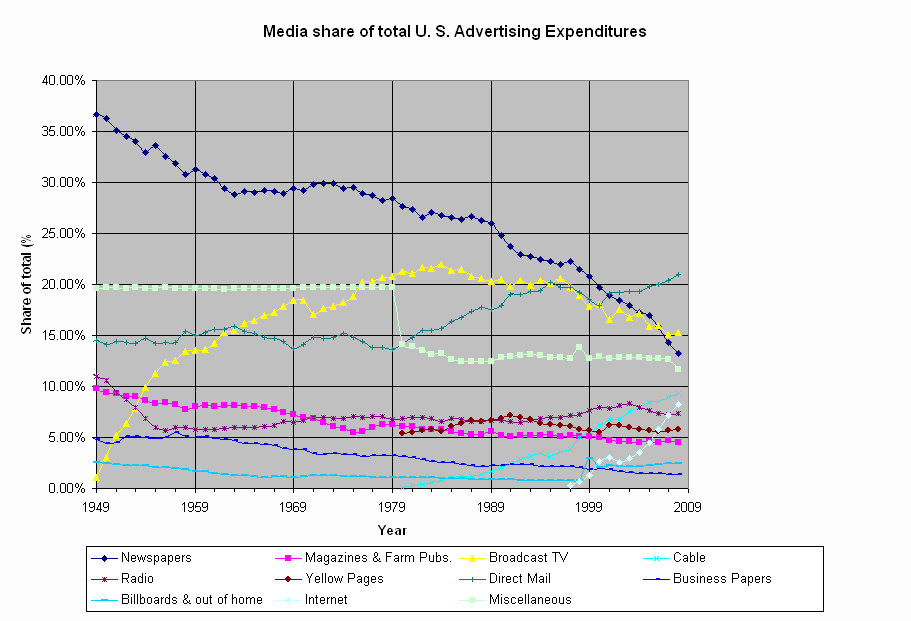
mychart(Data from Universal-McCann via the Television Bureau of Advertising; also from Internet Advertising Bureau, National Cable and Telecommunications Association.)

Yes, 60 years ago, newspapers took in 37 percent of all ad dollars in the U.S., and it’s been steadily downhill ever since.  (A century ago, it was probably 75 percent or more, but nobody was measuring.)  In 2008, preliminarily (some figures are still estimated), they’re looking at 13 percent, down from 18 percent five years ago. In a year or two, internet advertising (that’s the upwardly mobile line of light blue diamonds) will have a bigger slice than newspapers.  We know the reasons: loss of national advertising to TV, loss of monopolistic ad pricing power, loss of classifieds to Craigslist, etc.

Moreover, circulation is dropping like a stone (down 4.8 percent for the six months ending last September 30, and we’ll get a similar stat for the October-March period any day now).  As the print audience is lost, it disperses online and is not retained on newspaper web sites.

This doesn’t look like a formula for survival, so why is Michael Wolff wrong in predicting an 80 percent shutdown rate?  Because 73 percent of America’s newspapers have a circulation of 25,000 or less.  Another 13 percent were in the 25,000-50,000 bracket.  So 86 percent of the daily newspapers in America are in small towns and cities.  And yes, some of them lose money, because things are not good in those towns right now.  But the vast majority of those papers are profitable.  Not as profitable as they once were, but they were profitable during the Depression (I’ve seen some of the old P&Ls), they’re profitable now, and they’ll be profitable 18 months from now.

The problem is that newspaper owners have leveraged their cash flow to the hilt to make risky, ill-considered acquisitions that have now put many of them at, or over, the brink of bankruptcy.  Their larger assets — most of the top 100 or so papers (those over 90,000 or so in circulation) —  are probably in the red on an operating revenue basis, because they lack the grass-roots small-business advertising support the small dailies have, and are saddled with expensive real estate, distribution arrangements and union contracts.  Hence threats to close papers like the Boston Globe and San Francisco Chronicle.  But even if all the chains go bankrupt, operationally profitable assets like small-town dailies will be sold off intact, not shut down.

Even those metro-sized papers will, for the most part, survive the next 18 months, although most of them will cut further their distribution, their contents, and if they’re smart, their publishing frequency down to 1, 2 or 2 days a week.  In fact, I would agree with Wolff to this extent: 80 percent of the top 100 papers will not be seven-day papers 18 months from now (make that my first 2010 prediction).

In the hinterlands, 18 months from now, we’ll still find most of those 1200 or so small-town, small-city dailies — many with cuts in publishing schedules (to five or six days a week), paging, features, staffing or format, but carrying on as the voices of their communities. Those small dailies have the biggest opportunity, capacity and flexibility to innovate and find new models that can survive beyond the next year or two.   What they need is some leeway from headquarters to experiment so that some of them can discover the models that others can emulate.  They need to be digital enterprises 18 months from now.  If they don’t make that transition, plenty of new enterprises, including many with print components, will arise to show the way.

I just acquired a wood stove to cut down on my heating bills next winter.  I expect to be starting the fires, for quite a few years, with newsprint delivered by my local small-town daily newspaper.

Image from Gawker.com

______________

*Per the most recent compilation available from NAA, which is dated 2007, but the mix doesn’t really change much over time.

This entry was written by Martin Langeveld, posted on April 21, 2009 at 9:38 am, and tagged , . Bookmark the permalink. Follow any comments here with the RSS feed for this post. Post a comment or leave a trackback.


18 comments:

  1. Jay Rosen at 10:51 am, April 21, 2009

    Wolff doesn’t care if what he says is true. That’s an important thing to know about him. He’s into being provocative and then, when the arguments come about whether what he said is correct, he’s into telling you to f**k off. He enjoys being disliked. It’s strange package, but it hasn’t changed much over the years.

     
  2. Rob Weir at 1:25 pm, April 21, 2009

    Thanks for the response to that absurd assertion. All I’d add to it is that there are also thousands of weekly newspapers that aren’t going anywhere anytime soon.

     
  3. Rob Mitchell at 2:18 pm, April 21, 2009

    As the third generation in my families 2 small daily newspapers, I have been waiting for someone to notice what have you so eloquently pointed out: most of the newspapers in the US are smaller and more local than the big guys who are over-leveraged. We’re still here and we’re here to stay.

     
  4. Richard L. Floyd at 2:28 pm, April 21, 2009

    Martin,
    We’ve were just speculating yesterday on the future of our daily paper, the Berkshire Eagle, where you were once the publisher. It seems to get thinner all the time. Yet we concluded that somebody will still need to publish the obits, local sports scores, who has been murdered, arrested, indicted, convicted, and what the city council and the school committee are up to, and the like. I suppose there are places online to find some of these things, but the paper is a reliable, familiar vehicle, at least for older consumers. I’m guessing you are right, smaller market papers will stick around, at least for a few years. -R

     
  5. Ken Kennedy at 2:28 pm, April 21, 2009

    Nice to see people applying common sense. *grin* The downward-pointing lines on graphs don’t go down forever any more than the upward-pointing lines (stock prices, home valuations) go up forever…reality intrudes in there somewhere, in the form of the fundamental “stuff” underlying those graphs (which sure are pretty [and useful!], but completely abstract. Nicely explained, too.

    And I’m onboard with the “80 percent of the top 100 papers will not be seven-day papers 18 months from now (make that my first 2010 prediction)” prediction. Dropping days makes sense in a world where newspapers are already “a day behind” the news, and certainly allows them to drive costs down.

     
  6. Dave Barnes at 9:47 pm, April 21, 2009

    80% of newspapers will NOT be gone.

    But, 80% of newspaper creditors will have taken a corncob up their anal orifice.

    A newspaper that cannot screw its creditors is a newspaper with zero debt.

     
  7. tom mangan at 3:20 pm, April 22, 2009

    I’m reminded of that song “You picked a fine time to leave me Lucille’…

    I wouldn’t mind this meltdown so much if there were other jobs to be had out there.

     
  8. K. Veit at 6:56 pm, September 8, 2009

    Perhaps newspaper owners ought to look at themselves instead of Gooogle or the Internet. It seems it is what news they are publishing(or not publishing)is the cause. If they want to continue down the road to Liberalism or Socialism it will come at a cost to their circulation. A perfect example is their coverage(or no coverage) of the Van Jones affair.
    Ken


Trackbacks:

  1. Newspapers gave way to their own doom | Os jornais abriram o caminho à sua própria desgraça « O Lago | The Lake at 4:23 am, April 22, 2009

    [...] stir in the next few days will be all about the words of Michael Wolff that believes in “about 18 months from now, 80 percent of newspaper… I think he’s wrong, but many newspapers are doing a heck of a job trying to prove him [...]

     
  2. 80% novina izumrijet će u narednih 18 mjeseci  | propanightmares.net at 4:31 pm, April 22, 2009

    [...] Langeveld suprotavio se Wolfovom predviđanju o 18 mjeseci u kolumni koju je napisao za Nieman Journalism Lab rekavši “da se to ipak neće dogoditi”. [...]

     
  3. Is Michael Wolff Right or Just Attention Seeking? « No More Paper at 6:06 pm, April 22, 2009

    [...] On the one hand you’ve got Wolff fawning for the cameras and bitching about Craigslist when the fact that Craigslist now claims most of the classified ad content in the US is true but irrelevant. Yes, it happened and print can’t  sustain itself without that business. But local papers could easily outdo Craigslist in terms of localized personals (bikes for sale, etc.), they just haven’t gotten their shit together enough to do so. The problem is not just a loss of classified revenue, it’s a lack of ingenuity. That said, I still think most papers have got a little more than 18 months. [...]

     
  4. Editor&Publisher: Rectifying newspaper ‘myths’ | Journalism.co.uk Editors' Blog at 4:36 am, April 23, 2009

    [...] Also related: Nieman Journalism Lab: ‘80 per cent of newspapers gone in 18 months. Not likely.’ [...]

     
  5. 80% dos jornais serão extintos? | Converge Magazine at 11:52 am, April 24, 2009

    [...] Nieman Journalism Lab [...]

     
  6. ¿Es posible que desaparezca el 80 por ciento de los diarios estadounidenses en 18 meses? « [blog de rubén martín] at 12:14 am, April 25, 2009

    [...] que el 80 por ciento de los periódicos estadounidenses habrán desaparecido en 18 meses más. Martin Langeveld, del Nieman Journalism Lab, dice que esto es poco [...]

     
  7. Print isn’t dying, it’s morphing. You should be too. « Newstweek at 7:04 pm, April 28, 2009

    [...] it’s quite accurate. Newspapers are drowning in their own drool right now. According to The Nieman Journalism Lab , most of the large Newspaper owners are filing bankt or close [...]

     
  8. BLOG: Print isn’t dying - it’s morphing. You should be too. | Insight Magazine at 7:12 pm, April 28, 2009

    [...] it’s quite accurate. Newspapers are drowning in their own drool right now. According to The Nieman Journalism Lab , most of the large Newspaper owners are filing bankt or close [...]

     
  9. Jessica Pacheco » Blog Archive » Print isn’t dying, it’s morphing. You should be too. at 6:48 pm, May 6, 2009

    [...] it’s quite accurate. Newspapers are drowning in their own drool right now. According to The Nieman Journalism Lab , most of the large Newspaper owners are filing bankt or close [...]

     
  10. WorkingReporter Blog » Washington Post Closing Regional Bureaus at 3:15 am, November 25, 2009

    [...] things aren’t what they used to be,  Harvard’s Nieman Journalism Lab reports that the problem isn’t that some papers aren’t still making money.  They are.  [...]


Leave a comment

Check out these related posts