Archives: 2017

“Think of all these sites as the digital, non-linear television arm of Univision.”
“For a lot of people, the real assumption that they bring to the news, even beyond their partisan affiliations, is an expectation of a smooth narrative…That’s the real bias that readers have to combat, and it’s something that people in the media have to think about.”
The company, which publishes tech sites in the Mid-Atlantic, wants to grow beyond its core events revenue model while keeping community at the heart of what it does.
“This problem is creeping up the ladder, from the small town that has 10,000 people to the decent-sized community that has 50,000 people to, now, a place that has over 100,000.”
“We found a method that can invite a much wider readership into the work of dealing with this problem, and at scale.”
Adopting the role of a good neighbor does not mean abandoning critical perspective. It’s an opportunity to ensure that local newspapers are at the heart of the conversations taking place in their communities.
Newsrooms are struggling to apply traditional ideas about objectivity to the current moment, and some journalists are being caught in the middle.
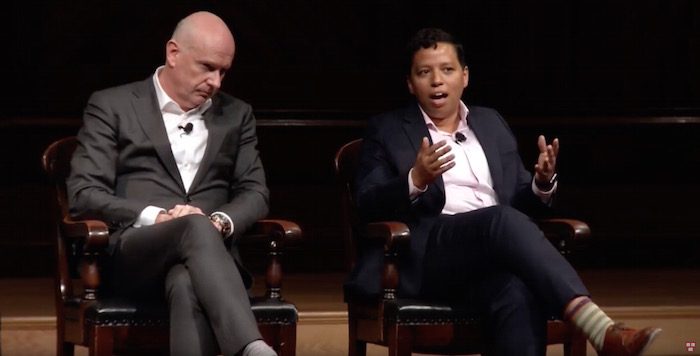
Reporters and editors from prominent news organizations waded through the challenges (new and old) of reporting in the current political climate during a Harvard University event on Tuesday night.
Top journalists from The New York Times, The Wall Street Journal, The Huffington Post, and the Nieman Foundation discuss the path forward for reporting in the Trump era.
“It’s one of those things that a lot of us had gotten into our business to do: to have impact, to change the world, whether you worked for the opinion pages or the newsroom.”
“Many Americans — I would say, on a positive day, most Americans — do care about sources of information, do care about the truth.” Brian Stelter
“I’m here to remind you today that great journalism can also find ordinary, regular people and find the extraordinary in what they do.”
“Joe McCarthy, you know, was very successful before the Internet, before social media. George Wallace won five states in 1968…So I think it’s too simple to assume that all of our problems are due to this.”
“I am an absolute stickler in all of our coverage for precision in language because, as you say, words are loaded. They have political meanings, they have cultural meanings, and they have identities that go beyond simple words.”