“The question is not about the topics but how you approach the topics.”
 Not in Miami? You can tune into the Knight Media Forum 2020 from your desk. #kmf20 nie.mn/32o3lii
Nieman Lab Wire
The last 20 posts from the Nieman Journalism Lab, for those who enjoy reverse chronological order.

April 23, 2024

April 23, 2024
“Our research addresses deepfake detection algorithms’ fairness, rather than just attempting to balance the data. It offers a new approach to algorithm design that considers demographic fairness as a core aspect.”

April 22, 2024
“People will pay you to make their lives easier, even when it comes to telling them which burrito to eat.”
A new report has found gaps in the ad libraries of the world’s largest social media platforms, hindering basic transparency efforts ahead of a historic global election year.
The audit, published by the nonprofit Mozilla Foundation and the Finnish disinformation research company CheckFirst, found significant shortcomings in the ad libraries of Meta, TikTok, and LinkedIn, as well as major failings in the ad libraries of Alphabet and X (formerly Twitter).
Content from ad libraries has regularly been the foundation for investigations into pharmaceutical companies, e-commerce giants, right-wing influencers, presidential election campaigns, and foreign election interference. In particular, these libraries are an important tool for reporters looking to identify disinformation, paid influence campaigns, or the provenance of viral posts. They’re also vital for reporters who are tracking political messaging and voter targeting leading up to an election day.
In 2024, more than 60 countries will hold major elections and over half of the world’s population will be eligible to go to the polls. These ad libraries will be under immense pressure in the coming months, and the researchers claim most may not be up to the challenge.
“Ad transparency tools are essential for platform accountability — a first line of defense, like smoke detectors. But our research shows most of the world’s largest platforms are not offering up functionally useful ad repositories,” said Mozilla’s EU advocacy lead Claire Pershan in a release for the report. “The current batch of tools exist, yes — but in some cases, that’s about all that can be said about them.”
X, most notably, has no web interface. The ad library only provides slow-loading CSV files that create a huge amount of friction for any journalist trying to track or report on ads circulating on the platform at any scale. One CSV file often takes between five to ten minutes to load. Most basic ad library searches on other platforms take just seconds.
Once downloaded, there are no built-in filtering options, requiring journalists to convert the file to properly narrow the data. The content itself is not visible, showing URLs to the post instead. X also provides no help lines, tips, guidelines, or feedback — which puts up even more barriers to entry.
“X’s transparency tools are an utter disappointment,” said Pershan, echoing the report’s call for the company to build a proper ad library portal and better user experience.

Alphabet marked slightly higher in the audit, earning the grade of “bare minimum data and functionality.” The company currently operates a joint ad library for both YouTube and Google search, but has no keyword search option and does not allow you to filter the posts by platform. Users can only search by domain and advertiser name, making it harder to conduct even basic searches.
For YouTube, researchers could find 100% of the ads they identified in the library. But for Google Search that number dropped down to 67%, meaning a significant portion of ads were missing altogether.
Across the board, many of the ad libraries distinguished between advertising content and commercial “influencer” or “branded” content. Influencer posts in some cases are housed in a different library, but many platforms simply don’t collect information on branded posts at all. Years of research by election watchdog groups has shown that influencer posts and “sponcon” are often an important part of election disinformation and interference campaigns.
The report calls for platforms to collect more of these influencer posts, and roll out better tools to search through them.
The Digital Services Act (DSA), a European Union (EU) law that took effect last August, required major platforms to create a public and searchable ad repository. With EU’s June parliamentary election around the corner, the rollout and expansion of these libraries could not be more timely.
The report does credit some major platforms for increased transparency since the DSA was passed — in particular improvements at TikTok, Meta, and LinkedIn. Still, no platform received a full passing grade in the audit.
For example, Meta now has searchable historical data, going back six years, and filtering options to refine and narrow searches. The platforms still received significant knocks on performance. On Facebook, the researchers could only find 65% of the ads they identified in the library, showing again that ads were slipping through the cracks.
On TikTok, those figures were slightly higher, with 85% of ads identified on the For You Page, appearing in the ad library.
“Who pays for ads and how they’re targeted is crucial in helping watchdogs look out for the public interest — whether that’s fair elections, public health, or social justice,” said Amaury Lesplingart, chief technology officer and co-founder of CheckFirst. “In short, if you see an ad telling you that climate change is a hoax, you might be interested to know if that ad’s paid for by the fossil fuel industry.”

April 17, 2024
The legacy publication is leaning on AI for video production, a new breaking news team, and first drafts of some stories.

April 17, 2024
“I only make unimportant things now, but it’s all the unimportant things that really make up our lives.”

April 15, 2024
“While there is even more need for this intervention than when we began the project, the initiative needs more resources than the current team can provide.”

April 15, 2024
“I think risk aversion is the thing that’s killing our business right now.”

April 10, 2024
“If there are resources to be put to work, we must ask where those resources should come from, who should receive them, and on what basis they should be distributed.”

April 10, 2024
“Whether intentional or not, the legislation we examined created potential opportunities to diminish opposing voices and decrease media freedom — both of which are particularly important in countries holding elections.”

April 8, 2024
“Celestial events tend to draw highly engaged audiences, and this one is no exception.”

April 8, 2024
It would, um, “champion the same values of ‘truth and traditional’ as The Epoch Times” and, er, “nurture in the next generation of media professionals,” ahem, “the highest standards of personal integrity, fairness, and truth-seeking.”

April 4, 2024
“Reclaim Your Brain” acknowledges “the effect that the news cycle is having on us psychologically.”
The latest critique of The New York Times’ coverage of Gaza comes from an unlikely source — an indie game developer. Earlier this week, the Pittsburgh-based developer Molleindustria released its new parody game, called The New York Times Simulator.
The game puts each player in the seat of editor-in-chief. On its surface, the objective is simple: build the front page of the Times’ paper each day. That includes choosing the stories and the headlines and where they’re placed on A1.
Stories that feed into the pipeline include news on union drives at Amazon factories and the latest in climate research, alongside frothy lifestyle coverage. A headline like “Biden Said He Would Stop Drilling. Then Reality Hit,” pops up alongside a story called “Why Are Grapes Suddenly Everywhere?”
But there’s an emphasis across the game on coverage of the war in Gaza, where over 30,000 Palestinians have been killed by Israeli airstrikes, IDF forces, and humanitarian aid blockades.
In the game, decisions on how to cover the war have consequences…for the paper’s bottom line. Three “interest groups” closely observe every turn in the simulator and gauge charts display the real-time approval level of “The Police,” “Israel,” and “The Rich.”
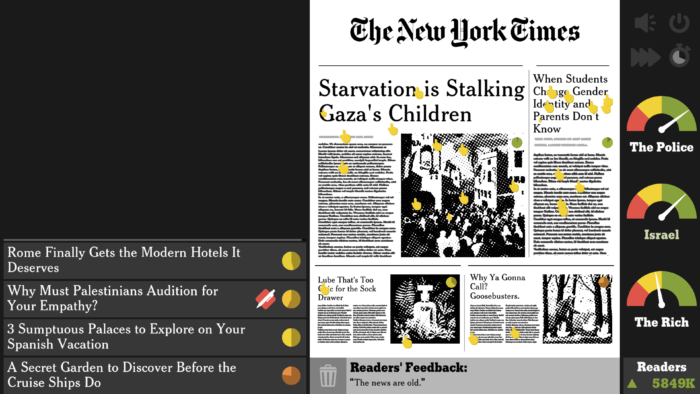
Though readership starts at 500,000, that figure will also jump up and dip down depending on your selections. The impact of each choice is only magnified when you put that story “above the fold.” Ultimately, the goal of the game is to build a readership of 10 million subscribers, without getting fired.
There’s no clear one-to-one cause and effect in the simulator, since it never fully lays out its internal logic. But as you play, patterns become clear.
For example, one of the fastest ways to alienate your “interest groups” is putting a story front and center with an uncompromising view on Israel’s killing of Palestinian civilians, or one that labels it a genocide.
There are ways around this. Pressing the edit button reframes a story, tweaking the wording of the headline, and potentially lessening its negative impact. “Israel is Starving Gaza’s Children” suddenly changes to “Starvation is Stalking Gaza’s Children.”
That is a real opinion piece headline that ran at the Times in February, by the way. In fact, Molleindustria’s release notes called the entire game “ripped from the headlines.” And many of the most damning ones in the simulator are pulled straight from the source.
Alongside the game, the developers released a public Google Sheet linking out to 107 stories used in the simulator. The majority of Times headlines are verbatim ones that have been published in the past year. A handful, though, have been slightly altered or pulled from other major news outlets, including CNN, NBC, and The Washington Post.
Headline edits are, in part, lifted from the media accountability tracker, NewsDiffs, which runs the bot account, Editing TheGrayLady on X.
The New York Times Simulator is just the latest satire game from cult indie developer Molleindustria, who has been publishing experimental fare for nearly two decades. The moniker is used by Paolo Pedercini, who is also a professor of game design at Carnegie Mellon University. In the past Pedercini has taken aim at McDonald’s in a Farmville-style depiction of a cattle slaughterhouse, and the fossil fuel industry in a globe-trotting game of resource extraction called Oiligarchy.
The New York Times Simulator is also riffing on games outside the studio’s archive, which have similarly tried to capture the ethical and business decisions that go into running a news publication.
The release notes mention the 2012 game The Republia Times as inspiration. That game similarly puts players in the role of editor-in-chief, sifting through headlines to build the front page of a fictional paper of record. But players in that game are up against the censorship regime of the fictional authoritarian Republia government.
This latest update, Pedercini says, isn’t to call out censorship as much as it is to “train players to quickly identify common spinning and framing techniques.”
In particular, he notes the routine use of the passive voice in Times headlines, which remove the state of Israel or police in the U.S. as actors in stories about violence. A package profiling Palestianians killed in Israel’s bombardments, for example, is headlined “Lives Ended in Gaza.” In the domestic coverage, he points out the frequent use of biased euphemisms, like “officer-involved shooting.”
“I originally wanted to make parody headlines,” writes Pedercini. “But I just couldn’t come up with anything more shameless and contrived than what’s already out there.”
A previous version of this story referred to over 30,000 deaths of Palestinian civilians, but, as NPR notes, the death toll “does not make clear how many militants are among the dead.” The New York Times reported on February 29 that “many experts say the official toll is very likely an undercount, given the difficulty of accurately tallying deaths amid unrelenting fighting, communications disruptions, a collapsing medical system and people still believed to be under rubble.”

April 3, 2024
“We know this may not be seen as traditional journalism, which is generally known for being dispassionate, reliant on inside sources, and indifferent to profitability.”

A new report, however, finds good news for podcasts in underlying media habits. According to the annual Infinite Dial survey released last week, more Americans are listening to podcasts — and listening to them regularly — than ever.
Edison Research surveyed 1,086 U.S. teens and adults for the report. The results showed 67% of people in the U.S. (12 and older) have ever listened to a podcast, 47% listened in the last month, and 34% listened in the last week.


Pierre Bouvard, chief insights officer of Cumulus Media, argued podcasts are no longer “a niche platform lacking scale” in a blog post for marketers. (Cumulus Media is listed as providing support for the report, along with audio peers Audacy and SiriusXM.) “Podcasting deserves a larger role in media plans as opposed to ‘test and learn’ experimental buys,” Bouvard writes.
The percentages are even higher when you look at younger Americans. The report found 59% of those under 35 — and 55% of those under 54 — listen to podcasts at least once per month.

The gap in podcast listening between men and women has narrowed. This year, 45% of women and 48% of men reported listening to a podcast in the past month. (The 2023 report found 7% more men listening weekly than women.) Women who listen to podcasts weekly listen, on average, to two more episodes per week than their male counterparts.
The survey also found that smart speaker ownership may have peaked. Slightly fewer (34%) reported owning a smart speaker than the year before, though nearly half of those who do own smart speakers said they own three or more of them.
You can read the full report here.

April 2, 2024
“I think sometimes we get stuck in an echo chamber of being around each other a little too much. And I think that can hinder some of this work.”

April 1, 2024
Ten years ago today, a new app arrived to strip the “media” out of social media, reducing messaging to two little letters. It burned bright, but not for long.
The Atlantic has surpassed one million paid subscriptions and is profitable, according to an announcement from the company Thursday. Fifty-six percent of the subscriptions are digital and 44% are print/digital bundles.
In an email to staff sharing the news, editor-in-chief Jeffrey Goldberg and CEO Nicholas Thompson wrote, “The key to continued success is to be constructively dissatisfied with the present, and so both of us believe very strongly that our 1 million subscriptions represent merely the foundation of future excellence and growth. Profitability is also perilous in the media industry, and we are going to continue to be highly disciplined in how we run our operations.”
The Atlantic’s revenue rose 10% last year to nearly $100 million, with two-thirds of it coming from subscriptions, according to The Wall Street Journal. (When Thompson became CEO in February 2021, less than half of revenue came from subscriptions, the Journal noted.) It raised subscription prices: An annual digital subscription cost $50 in 2021 and now starts at $80 (a combined print/digital subscription with no ads on the website is $120 per year). The Atlantic also shifted its editorial strategy to cover large issues more deeply (garnering 36,000 subscribers in the first month of the pandemic in 2020 for its coronavirus coverage) during a two-year listening study of what its readers want and need. In November 2021, the magazine experimented with newsletters as a subscriber perk, bringing nine Substack newsletters into the fold and turning them into paid, subscriber-only emails.
The Journal also outlines The Atlantic’s success with Apple News+:
Additionally, the publication has about 100,000 users who read the magazine through Apple News+, a product that charges a discounted price for access to a number of magazines and news publishers. Thompson said the Atlantic gets roughly the same amount of revenue from everybody Apple counts as an Atlantic subscriber as it gets per direct subscriber.
The success is a turnaround from May 2020, when the company, owned by billionaire Laurene Powell Jobs, had laid off 68 employees, mostly in its video and in-person events departments. Per The New York Times, The Atlantic had 500,000 paying subscribers at that point, meaning the company added another half a million subscribers in just under four years.
Goldberg told the Journal that The Atlantic is now experimenting with artificial intelligence and is “building an experimental website and app with AI features, such as AI-based games and search.”

March 28, 2024
Phoebe Connelly on prompt training, AI anxieties, and her first-of-its-kind role

 Encyclo: Our encyclopedia of the future of news. We've got all the most important players in journalism's evolution.
 Download the Lab's iPhone app — it's the best way to stay up-to-date on the future of news. It's free and available now in the App Store.