


Last fall, in our Predictions for 2015 package, Jamie Mottram of Gannett predicted we’d see an increase in SMS sharing. He cited the impact a SMS share button had had on Gannett’s sports site For The Win:
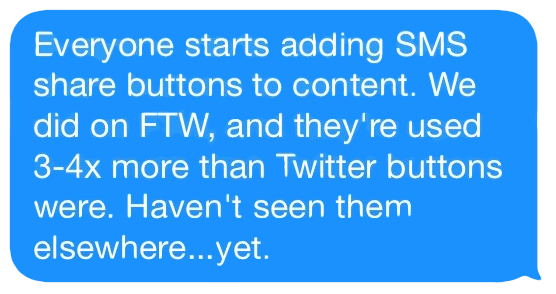
I’ve seen a few more texting share icons pop up here and there, but it’s unclear how big a driver of traffic they are. (Dark social!) So I asked one news organization that knows a thing or two about social — BuzzFeed — what they were seeing in their BuzzFeed News app.
 BuzzFeed News puts more care into its sharing experience than most, creating attractive story cards like this one for texting (and other platforms).
I asked BuzzFeed’s Stacy-Marie Ishmael if she’d share data on which share options get used most often. Among Facebook, Twitter, and texting, I think conventional wisdom would be that Facebook’s the most popular (the goliath!), Twitter next (the one all the journalists are on!), and SMS third.
But it’s the opposite:
@jbenton this is one day's data, across iOS and Android, ranked by % of shares that day. Pretty representative. pic.twitter.com/h4EedRMiMH
— stacy-marie ishmael (@s_m_i) October 22, 2015
(Also note Reading List ahead of Pocket ahead of Instapaper. And good ol’ email is still strong.)
We’ve written a number of times about the rise of chat apps (Snapchat, WhatsApp, WeChat, Line, Kakao, Kik, etc.) as distribution platforms, and that’s very true. But don’t forget about humble old SMS. If you make it easier for your readers to share via text on mobile, they just might take you up on the offer.
@jbenton the popularity of SMS surprised us too (so we made sure we made that experience great)
— stacy-marie ishmael (@s_m_i) October 22, 2015


