
Google developing a micropayment platform and pitching newspapers: “‘Open’ need not mean free”
Google is developing a micropayment platform that will be “available to both Google and non-Google properties within the next year,” according to a document the company submitted to the Newspaper Association of America. The system, an extension of Google Checkout, would be a new and unexpected option for the news industry as it considers how to charge for content online.
The revelation comes in an eight-page response to the NAA’s request for paid-content proposals, which it extended to several major technology companies and startups. It’s surprising, given the newspaper industry’s tenuous relationship with Google, that the company was involved at all.
In the document, which you can download here, Google outlines its “vision of a premium content ecosystem” that includes subscriptions across multiple news sites, syndication on third-party sites, accessibility to search, and various payment options, including small fees for access to individual pieces of content (known as micropayments). The company says:
Google believes that an open web benefits all users and publishers. However, “open” need not mean free. We believe that content on the Internet can thrive supported by multiple business models — including content available only via subscription.
Google describes its new e-commerce plans as “in production” and “currently in the early planning stages.” The company says that Google Checkout is currently equipped to handle subscription payments for news sites but describes the process for merchants as “fairly rudimentary” and says the system “could be improved to be more relevant for news and media companies.” The description of Google’s micropayment system is more intriguing:
While currently in the early planning stages, micropayments will be a payment vehicle available to both Google and non-Google properties within the next year. The idea is to allow viable payments of a penny to several dollars by aggregating purchases across merchants and over time. Google will mitigate the risk of non-payment by assigning credit limits based on past purchasing behavior and having credit card instruments on file for those with higher credit limits and using our proprietary risk engines to track abuse or fraud. Merchant integration will be extremely simple. [emphasis theirs]
Transaction costs, including credit card fees, are a major hindrance to micropayment plans under consideration by the news industry, which is why Google’s proposal could be appealing. Of course, newspaper companies that have frequently accused Google of leaching off their revenue might be loathe to participate in a joint venture.
In a brief paragraph entitled “business model,” Google suggests that it would share revenue in a similar fashion to the iTunes App Store and its own Android Market, both of which take a 30% cut of revenue. But while these plans are emerging from Google’s communication with the NAA, the micropayment system is likely to have bigger implications outside of the news industry. In the same document, Google douses some cold water on micropayments for news: “We do not believe it will be the norm for accessing content.”
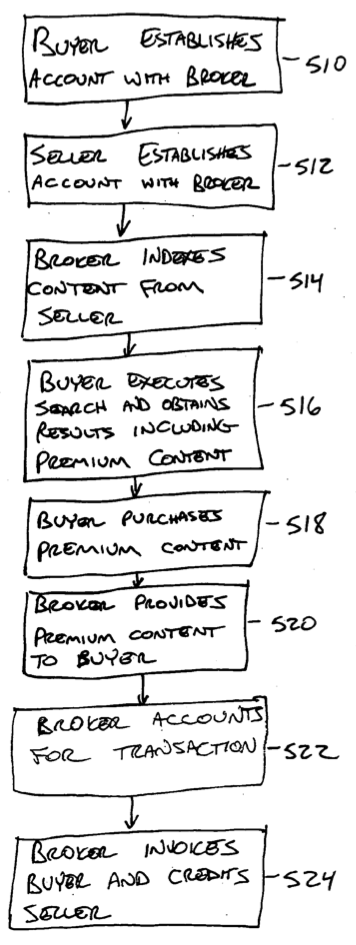
Google Checkout has longed been discussed as a potential micropayment platform and competitor to eBay’s far more successful PayPal. Google applied for a patent on a micropayment system in 2004; on page 7 of the application, Google mentions that “a seller of web-based electronic content, such as newspaper stories, typically has a purchasing system that is valid for only the website providing the content.” A crudely drawn diagram describes Google’s proposed alternative:
Google’s document for the NAA also discusses publishers syndicating their content on third-party sites and sharing ad revenue, which sounds like what the Fair Syndication Consortium is proposing. There are also a few paid-content scenarios that are worth checking out, including:
We envision the typical scenario to be where a user pays a monthly fee for access to a wide-ranging package of premium content. One example of a “package” might be full access to the WSJ [Wall Street Journal]; another “package” might include the top 10 business publications. Google believes that there is real power and benefit to publishers in providing these sorts of broad, multi-publication access passes.
I’m waiting on comment from Google. UPDATE, 5:21 p.m.: Here it is:
The Newspaper Association of America asked Google to submit some ideas for how they could use technology to generate more revenue from their digital content, and we shared some of those ideas in this proposal. It’s consistent with Google’s effort to help publishers reach bigger audiences, better engage their readers and make more money. We have always said that publishers have full control over their content. If they decide to charge for it, we’ll work with them to ensure that their content can be easily discovered if they want it to be. As for Checkout, we don’t have any specific new services to announce but we’re always looking for ways to make payments online more efficient and user-friendly.
There’s much more to explore in the NAA’s report, which was produced by a task force of newspaper executives charged to explore “platforms for monetizing digital content.” (The committee was formed after the NAA’s secretive meeting in Chicago last spring.) I’ll update with more as I get to it, but if you see anything good, feel free to drop it in the comments or contact me by email.
Here’s the document that Google submitted to the NAA:







Wow. They did a good job of keeping this quiet during Aspen, from what I heard in the livestream.
I’m very interested to hear the reactions of others getting into this area and what possible affect this news might have on them.
Google may be the company that is best positioned to actually implement something like this – but the big unanswered question is: will people (or enough people) actually use it?
On a related note, this would pretty much drive a stake through the heart of Steve Brill’s Journalism Online venture.
I agree with Mr. Ingram. I think that Google is the company that is positioned to do this and do it well. They know more than anyone how this has the potential to work. News folks have been saying Google killed newspapers, but now they be the company to save them too.
“We envision the typical scenario to be where a user pays a monthly fee for access to a wide-ranging package of premium content.”
Would anyone object to that? A resonable fee for wide-ranging access to avert what appears to be the inevitable loss of newspaper / media “premium content” as traditional media implodes?
Every post that brings up the canard about Google leaching profits from newspaper websites — even if you’re just referring to that as someone else’s belief — should immediately include the fact that Google sells NO advertising against Google News.
None. It is not making money off that page.
Now you understand why the publishing business is in so much trouble, they just don’t keep up with recent developments. Apple pulled off the same stunt with iTunes, sneaking up on the labels as a massive distribution point, the terms of engagement for which was determined largely by Apple itself.
So, now the newspapers want to do the same thing. Instead of fixing the fundamental problems they have in content costs – in terms of production, distribution and marketing, they are taking the easier (lazier, anyone?) route and asking Google to monetize it for them.
Schmidt must be laughing his head off at Mountain View right now.
I believe the Chagora model is a better one. Though designed to enable networked political contribution as a trigger, its broader function includes enabling the microtransaction for purposes just such as this.
It’s also a simpler and cleaner design.
I’m afraid I’m just a lone political theorist but I think I’m beginning to get this getting across!
See the Fixing Big! PowerPoint available via the Chagora Site and my blog at http://CulturalEngineer.blogspot.com
You tell me…WOULD you pay for such content when in fact it probably is FREE on the internet?
now if this is a paid service in which the particular info is compiled to you as a custom retrieval and your too lazy to do about and get it thats fine but other may want to “let the fingers do the walking” and access it instead. Time and time again the only thing that beats FREE is when they PAY you to access it and THATS with no surveys or sitting thru a video trying to see you some property that underwater 90% of the time.
actually google just created a roadmap for amazon.
checkout has the problem of not enough users and not enough momentum from this concept to entice people to sign up.
Amazon on the other hand has everyone’s credit card. If they were to create cross publisher subscription and offers , along with kindle integration, they could easily pre empt google.
IF they make their splits with publishers more reasonable
Amazon could create an amazing subscription environment that crosses over to books, video, news, anything and everything digital..
could be incredible
This is interesting. Google is looking to make amends after being squarely blamed by publishers for the state of their industry.
That’s a good point, Mark — Amazon might be better positioned to do this than Google. Does anyone actually use Google Checkout?
Google checkout usage is very low, in the low single digits (we have proprietary data on this, measured at both points of the transaction). I don’t agree that Amazon can easily preempt Google on this based on the number of consumer credit cards they have on file. However Amazon is a threat for another reason: they are an electronic publishing broker with tremendous market power, and they have two payment capabilities that are essential here: 1) fraud management for online transactions and 2) ACH *non*-card based) payment connections between consumer and bank. This is, at once, a potential game-changer to both the traditional publishing and payments industry. As for Google, until they gain an understanding of how consumers and merchants use payments and financial services Checkout will not be a serious threat.
a great plan of Google’s product expansion which would open up many avenues in payment and processing industry.
I have a question: What amount would be enough to support the editorial operations of these big media companies?
My big problem with this entire discussion (re: paid content), is how does it generate enough revenue to support operations?
The reality is, correct me if I’m wrong here, readers don’t support editorial products with the money they have spent buying papers or magazines, it’s always been (at least most of the time) advertisers.
Yet advertising rates are plummeting, are certainly are much less online than in print, and they are jumping from newspapers to other places, such as advertising directly on Google.
So, how does this solve the main problem, which is to keep editorial a viable business? This seems like a great thing for small-time media companies trying to make some cash online, but it won’t save the New York Times. Will it?
It’s a fair point, Doogie, that Google isn’t making much money off Google News at the moment, but in fact, they have experimented with limited advertising there.
Mark’s observation about Amazon, which he expanded on in a post, is a good one. I think it’s also important to note, as I say in the post, that a micropayment system by Google (or Amazon) is likely to have far greater implications for media outside the news industry. Actually, I’m kind of surprised the reaction to this story has focused so much on what Google could do for newspapers; that’s certainly not Google’s focus.
And, Stuart, there are no simple to your questions, but the net profit that Journalism Online is projecting for newspapers would not, in most cases, entirely account for the decline in print advertising revenue. And then there are those, including some commenters here, who think JO’s figures are too rosy. That may be. —Zach
So Google would then know every micro-payment even those outside of their already enormous reach?
The ONLY way I could see this working (sociologically, not technically) is if the “micro-payment clearing house” either had to make all of this data open for all and sundry (you know, even playing field, open web, that sort of stuff), or they were precluded from data mining it.
The Google news payment system is a interesting idea, but it fails to address a fundamental problem with the newspaper ad model. Newspapers today rely on display ad’s. The problem is that this advertising is very conducive to web advertising. Google should implement it’s Google adword system on newspaper sites. Google could offer to share ad revenue with the newspapers. By requiring login to Google news the ads could be highly targeted. The micropaypent system is not enough to save the newspaper industry.
Google is correct in its assessment, but what they propose is nothing new. Such systems already exists, and… sorry to say that, NAA has already rejected them.
At least they rejected our Znak it! platform, which offers not only VERY SIMPLE and SAFE subscription processing, but also “on demand” two-click access/payment and pay-as-you-go options, so that the users do not have to spend $50 upfront; they can purchase premium content for 10 or 25 cents a piece, if they want to, and then, spend the rest on games, music or other virtual goods (by providers smart enough to offer micropayments).
Also, I am a bit surprised that Mark Cuban (if this is THE ONE) seems to like micropayments now, or that he recommends them for Amazon’s Kindle. When we sent him our proposal, saying that at one point HP and Amazon expressed some interest in Znak it!, as the possible platform for the new Kindle, he didn’t even respond.
I think it will be another great application by Google. Way to go Google!

