
Paying for online news: Sorry, but the math just doesn’t work.
The morning’s RSS scan brings another couple of entrants in the ongoing conversation about paying for news on newspaper web sites:
- As Roy Greenslade reports, News Corp. chief Rupert Murdoch favors charging: “People reading news for free on the web, that’s got to change.”
- And in an AJR article by Paul Farhi questioning the wisdom of AP’s decision, years ago, to start selling its content to online-only publishers, AP president and CEO Tom Curley is quoted as favoring reader fees, as well: “The readers and viewers are going to have to pay more. Advertising is not there. Advertising will likely be contracting. So there has to be a shift. If I had tried to suggest this a couple of years ago, I’d be hollered out of the room. Last year the realization started to occur. I would say the conversation has now turned from a whisper into a roar. Media CEOs are saying, ‘I’ve got to charge.’”
OK, newspaper CEOs, let’s have a look at that urge to charge you’re roaring about every morning when you wake up. I ran some numbers derived from the NAA’s just-reported 2008 newspaper revenue recap. Here’s what the back of my envelope says:
Total 2008 newspaper online revenue was $3.109 billion. Newspaper sites averaged 67.3 million monthly unique visitors in 2008, nearly all of them to free content. Now suppose a switch were turned, and each and every newspaper started imposing a monthly fee on all those visitors. Whether in the form of a monthly subscription or micropayments, clearly, the UV count would drop significantly.
I assumed that an industry-average $1-a-month fee would reduce traffic by 30 percent, $2 would knock off 50 percent, $5 would chop out 70 percent, $10 would say goodbye to 90 percent, and $25 would wipe out just about all of it. And further, I assumed that the 2008 ad revenue level of $3.109 billion would be reduced by the same percentage as the visitor reduction (which is probably a generous assumption).
So the question becomes: Will the new monthly fees offset the lost ad revenue? Here’s what happens:
- At $1 a month, with viewer retention of 70 percent, subscription revenue would be $566 million. But ad revenue would drop by 30 percent, or $933 million, for a net loss of $367 million.
- At $2 a month, with viewer retention of 50 percent, subscription revenue amounts to $808 million. But newspaper sites would kiss away half their ad revenue, or $1,555 million, for a net loss of $747 million.
- At $5 a month, and 30 percent of visitors sticking around, subscription revenue swells to $1.212 billion. But 70 percent of ad revenue, or $2.173 billion takes a walk, cutting the net by $946 million.
- At $10 a month, sites retain just 10% of visitors, who pay a collective $808 million for the privilege, but 90 percent of ad revenue ($2.798 billion) flies the coop, leaving newspapers poorer by $1.990 billion.
- At $25 a month — well, I won’t bother with the arithmetic. Make your own assumptions, but nearly all the ad revenue goes away and viewer fees don’t replace more than a small fraction of it.
Are these viewer retention assumptions valid? Granted, they come from the top of my head. If you disagree, make your own assumptions; the math is simple. We don’t have a lot of real-world before-and-after figures from news sites that have imposed fees. But we know, for example, that the New York Times’s 2005-2007 Times Select experiment drew 227,000 paying customers at an average of about $3.70 a month (based on reported revenue of $10 million a year), at a time when the Times’s free content was drawing 13 million unique visitors a month — a conversion rate of less than 2 percent. Or consider that the Wall Street Journal has about a million paying subscribers at $8.66 a month, versus 14 million monthly UVs at the free New York Times site. Print circulation for the two are roughly equivalent, but the Journal’s fee cuts its online audience to just 7 percent of the Times’s.
Based on this, retention rates as high as those I’ve modeled don’t look attainable, and retention high enough to increase net revenue is plainly not in the cards. (To get a net gain at a seemingly reasonable $5 a month rate, retention would have to be about 45 percent.)
A simple tollbooth approach at any price cuts out the vast majority of the audience, and would mean that newspapers were retrenching to print — saying in effect, “If you want our news online, it’s there, just pay the fee, but we’re no longer investing much energy in developing our sites, because there’s no money on that side of the fence.” A newspaper industry retrenchment to print would mean a withdrawal from competing online. The game would be to squeeze the remaining profits out of print while the clock runs out; while readers continue to migrate online, now to non-newspaper online-only sources; and advertisers follow the audience to the Web.
For newspaper firms to survive, they must become fully digital enterprises, engaging a broad audience online without barriers — although they may be able to charge for some very high-value content that goes beyond their core site offerings (see, for example, GlobalPost’s $199-a-year Passport service).
Daily print is not a long-term sustainable model, and forward-looking newspapers, rather than exploring an online paywall, should explore transitioning to a once- or twice-weekly frequency, focusing their print efforts on a weekend edition distributed Friday. (Explore my prior musings about this for more.)
UPDATE 4/05/08: Dutch blogger Marc Drees of Recruitment Matters has posted recap and commentary of this post, including a very nice graph summarizing my results:
(Red=paid content; Blue=advertising income; first column=present, 2008 baseline revenue per NAA)
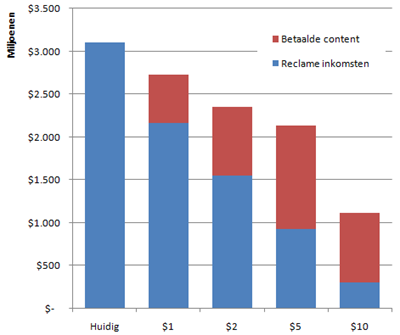
![]()


I’d bet the retention numbers are more skewed than that. I’d say $1 a month would chase away a lot more than 30% of readers — more like 60-70%. But I think there’s more elasticity at higher rates. I don’t think there are very many people who would pay $1 a month who wouldn’t also pay $5 — the key inflection point is paying anything vs. paying nothing.
All that said — uniques aren’t particularly useful as a sign of ad revenue here, since the people who’d be chased off by paying are likely to be the ones who generate one or two pageviews a month — the most casual reader. And the ones most likely to stick around are the ones who generate many dozens of pageviews a month.
Finally, I think there’s room for a hybrid model a la Financial Times, that allows the casual reader to check out a few stories a month but requires payment from the chronic reader. I’m a little more optimistic than you, Martin, that there’s a model to be found that still allows the casual readers to pay $0 but also generates some revenue from those who use the newspaper’s work the most (some of whom would be happy to pay).
I’ve just finished a digital content strategy for a large UK newspaper, coming to very similar conclusions as your own. The reception was dismissive at best, hostile at worst.
For many of the execs in the industry the digital world is the villian of the piece, and they just can’t make the psychological jump required to see that it might actually be their saviour, too.
the question is not what newspapers are going to do, is what traditional journalists are planning for the future.
news editors, production and distribution can no longer dwell under the same roof. Still, there is monetize value on in depth reporting. We just need to find a way to finance it, without the prints, the huge newsrooms and the truck the distribute the newspapers getting in the way.
Let me go on record as also believing that charging for access won’t work. But I wonder if papers that charged for access might also be able to charge substantially more for online ads, because they could make the case (as their print ad-reps do) that they have an audience proven to pay for products they want. Seems to me that’s a better bet for an advertiser that might be otherwise reluctant to place ads online.
What would happen if you cut back expenses to just reporters, editors, and a handful of salespeople and techies to run the sites?
It sure seems like there would be plenty of money to pay for good journalism if you didn’t expect it to also pay for the bloated corporate infrastructure that was created for a print medium.
Of course, then there wouldn’t be room for the current layers of millionaire executives and billionaire publishers… and that’s really the issue here, isn’t it?
I agree with Joshua Benton. The key inflection point is at free vs. anything at all. And anything at all includes just having to sign up. Just having to sign up to see a piece of news for free will chase away over half.
See, this isn’t about price so much as it is about convenience and the way people want to use the web.
You also don’t factor in the loss of PageRank, from people ceasing to link to the stories, and the loss of link sharing in social media circles. Both of these are decimated at any price, even free, by a paywall.
Martin, I think your estimate for lost advertising revenue is way too high, for two reasons other commenters have mentioned: (1) A loss of 50% of visitors will not results in a loss of anywhere near 50% of page views, since it’s the more casual visitors that will disappear first; and (2) a publisher should be able to charge higher CPM rates for a smaller, more dedicated (and paying) audience.
I’m curious how a “premium content” approach would work. This is where the vast majority of content is free but “premium” content lives behind a paywall of some kind.
Perhaps it’s not premium content at all, what if all content is free but the ability to comment and discuss is charged. What if the feature to view extended content (like extra photos, more notes from the interviews, recordings and other stuff) is pay-only?
Perhaps (and I’m not sold myself) there are hybrid models that would be effective. How do you price those out?
I am sorry I talk a big game but in reality I won’t pay a damn dime. I’ll stick to free sites, crowdsourced news and blogs.
Bravo for this simple yet insightful observation — as it would be impossible for all news outlets to simultaneously impose payment requirements, clearly those that do will lose subscribers to those that do not. Readers will pay only for the most valuable and unique content — unfortunately newspapers are in denial that most of what they offer is a commodity freely offered by many.
Instead of moaning about how technology is taking away that which it once gave (these newspapers are only possible because of twentieth century technology) it would be more interesting to truly innovate — why haven’t any newspapers launched a credible alternative to craigslist, for example? Its not that hard.
Just to clarify my thinking in the post: I’m not predicting that at $1 a month, sites would retain 30 percent of traffic, etc. I used those assumptions to model what would happen and to make the point the EVEN at those unlikely retention levels, newspapers would lose revenue overall. As Josh and Joel say, it’s possible that the retained readers are high-intensity readers, so that 10 percent of readers retained might translate into 30 or 40 percent of pageviews retained, but that still produces a net revenue loss. And yes, it’s possible that the smaller audience would yield a higher CPM, but it’s also possible that more newspaper sites would be lopped off national advertiser lists as too small to bother with.
Soon we will not need to guess at retention rates. Several newspapers, including the Seattle PI, have stopped printing daily newspapers, slashed staff, and are totally online. It has only been a month or so for the Seattle PI but there are probably other newspapers that have been at it longer. Can you get the real numbers from Seattle PI or other papers?
The Rocky Mountain Times also went out of print and is attempting to relaunch as the In Denver Times with a $5/month subscription price. If they get 50,000 subscribers they will launch the online newspaper.
Do you know of any real life numbers out there?
My (comparative) optimism comes from the idea that I think you can get some revenue from the 10% of readers Martin’s counting as “retained” without actually tossing aside the other 90%. In other words, I think a lot of that 10% would be willing to pay even if the other 90% could still free ride to a certain degree.
And I don’t think the “some have a pay wall, but not everybody” problem is as bad as you might think, once you get past the national papers. That is to say, yes, if the NYT went pay-only, the Washington Post would see a boost in traffic. But if the Austin American-Statesman went pay only, I don’t think the Houston Chronicle would see a big boost. Most local/metro papers are less substitutable than that.
(On local news, that is. On everything else — comics, NFL, home & garden — they’re incredibly substitutable. But that’s already the case.)
I’m with Marc Matteo. I see no reason why you couldn’t paywall stuff that contributes nothing to SEO anyway: more photos, video, Flash presentations, documents, and so forth.
I’d be wary of charging for participation, though, Marc. I think you want to encourage that as far as possible.
@Martin
we have put together a spreadsheet exploring different scenarios for paid online content for 50K and 100K circulation newspapers. We have run numbers on scenarios ranging from fully paid to mixed paid / free.
http://mediacafe.blogspot.com/2009/04/charging-for-online-content-new-updated.html
Same conclusion
I agree with Damon. Newsrooms need to be staffing more efficiently and spending less on executive compensation.
Also – I spend money online for three things: tangible products (shoes, flowers for my wife) services (Flickr Pro, Netflix) and good causes (Mustaches vs. Cancer, MinnPost, MPR).
I never want to be forced to pay money for news and information.
However, I contribute money to news organizations I think are managed wisely and are producing valuable content. So far, those have been non-profits like MinnPost and Minnesota Public Radio.
One question I have is: Can news organizations offer any other products or services that might help subsidize news gathering?
@Nancy Wang — Thanks, that’s a great spreadsheet, obviously a more sophisticated analysis than mine, but clearly it shows no gain except in the implausible scenario of 100% conversion of paid print subscribers to paid online subscribers.
If you’re looking for more real figures, the French daily newspaper Le Monde has a paid zone. They have around 3 M/UV (Nielsen) for the free part of their site. Around 50,000 people pay 6 euros/month (about $8) for the paid zone. Which is 1.7% of their UV. Print paid circulation: 336,000 (OJD).
I have just the thing for you – an economist’s calculator – it guesses to 12 decimal places.
@Peter Ralph: Heh, thanks, but I’ll stick with my SWAG calculator!
The people who regularly go to a paper’s homepage in order to browse content would probably be willing to pay for it. The people who only look at an article because they were led there by a link in an email, blog, etc. might not be willing to pay, but if they click on the link and land on an article preview, like you do with archived content, wouldn’t you still be getting a page hit and advertising?
The whole getting “paid for content on the web” is a replay of the music industry.
These days the model in the music business is music pretty almost for free. The music companies get a little piece. The musicians make money by doing concerts and selling hats, tshirts and other chatkes to their fans. Apple makes money selling ipods and iPhones.
I’m betting it’s going to work out pretty much the same for “newspapers”. Use the web to aggregate fans. Sell them stuff they will buy. Meanwhile sell print ads to local business.
Some people will pay for certain kind of words. But it’s a niche market. Meanwhile, the publishers don’t have the power to do it. Is the Guardian or NPR or Politico going to charge for words? The publishing companies are no clothes emperors.
I think you cannot “assume” the loss of UV if papers go to a pay model.
One thing that needs to happen to make it work is that in a community with multiple papers, ALL need to adopt this model. Where would people go if all the papers in NY went to an online pay model? One newspaper towns in midsize cities would probably thrive more than you think.
The NY Times Select model would then be more successful. Charge just for the unique content…columnists, op-ed, etc. I really don’t think you would lose as many online visitors as you claim.
Great discussion! Thanks!
As an online (not print) publisher, I think this is one of the first realistic articles I’ve seen on this subject. My guess is conversion rate (at any price point) would be 1% or less, because readers can “go elsewhere” for most content they care about. I think your comment about transitioning their print to once- or twice-weekly and a weekend edition is right on the spot. Personally I’d run the print business as a legacy business, running extremely lean to serve the “never going to go digital” crowd at a profitable point, assuming that business will go to near-zero, and figure out how to leverage the brand/goodwill in the newspaper brands into a new, highly optimized, low cost online operation.
I agree totally with the premise – but I think the numbers are a bit off here.
According to the Albuquerque Journal’s experience with paid (in the recent NAA report) they lost 20% traffic up front when they started charging.
You can argue what the longer term impact is: back-of-the-napkin math seems to indicate they are underperforming their potential by 50 – 60%. But, that is with an $80 fee annual for online only.
And, the key is most of their Web traffic seems to come from print readers who get online access included in their subscription.
So as long as you are providing ‘free’ Web access to print subs, it is possible your traffic won’t drop below 40 – 50%.
Of course, even at that rate the loss of CPM revenue outweighs the gain in subscription income.
Here are the EVEN points:
US$ 1 monthly, around 79,38% retained users.
US$ 2 monthly, around 65,81%
US$ 5 monthly, around 43,50%
US$ 10 monthly, around 28%
To me, the 1 dollar fee does not sound crazy at all. The 2 dollar either even less crazy. The rest is up for discussion.
http://spreadsheets.google.com/ccc?key=pJvyBCdvgNaVuvEmBYTAQKw
Martin, you say: “it’s possible that the smaller audience would yield a higher CPM, but it’s also possible that more newspaper sites would be lopped off national advertiser lists as too small to bother with.”
But most newspapers get national advertisers only through national networks, which pay the publishers peanuts. If you look at MinnPost.com from anywhere outside MN, you see Google ads. This accounts for 30% of our traffic, but well under 5% of our ad revenue. In MN, you see banners for which we might get 20x the CPM rate that the national networks offer us.
I don’t know whether charging for content will work. But I do know that it’s a mistake to assume that more page views = better business model.
The idea of charging for the truly unique content such as editorials while giving the general news that everyone reports for free away is an interesting one. On a similar note, what if they charged based on the timeliness of the information. For the casual, non time-sensative browser, give them all stories posted for longer than say 1 to 3 days old for free. This would also still allow all stories to get spidered by search engines (which takes time anyway) and linked to. Then, for people the need the most up to the minute information, charge them for the service of providing that. The way in which communication tools continue to evolve make recycled news easier to produce and distribute, so a lean team focusing on truly unique news and incorporating time based access into it may be something to consider. Anyone know of any current examples of this model?
One more point that I think often gets lost in these discussions: In most markets, readers can get a roughly equivalent news and information from tv news sites. So the introduction of pay walls would see readers flee the newspaper sites for tv sites. While not widespread, in several markets, tv sites already have a larger audience than the newspaper’s. Publishers and editors need to face up to the fact that this is a much more competitive environment.
It amazes me how frequently those pushing newspapers to innovate on the content side are also those demanding newspapers should not innovate on the revenue side.
Your calculations are, as you say, off the top of your head. You don’t appear to be including in your model the print subscribers who also read content online, who represent a significant percentage of online audience and who would presumably have free access in any paid system. You only experiment with the most extreme, all-or-nothing paid model, not a tiered model like the Financial Times, not a voluntary model like Kachingle.
But, much more importantly, you yourself say you don’t have a lot of historical data to work with. We have TimesSelect, which can be interpreted in many ways and is not the end-all and be-all. Your conclusion that paid content can’t work is a product of your philosophy, not experience.
Please. Please. Stop insisting that paid content can’t work. Stop discouraging newspapers from making experiments, even bad ones. Unless you have a better answer that’s ready to go right now, you should be encouraging new ideas, not coming up with reasons to not even try. Demand that newspapers try ideas you’re sure won’t work; at least that way we can move on to the next idea.
We are in an era of crisis. Radical, foolish, gambling innovation is welcome. Naysayers need not apply.
@Working Reporter: Good points, and I’ll repeat that I’m clear about saying there’s guesswork and assumptions in my model. Nancy Wang in Comment 15 provides a link to a more sophisticated model she has posted, that reaches the same conclusion. Jeff Jarvis, in Trackback 2, mentions that he will have MBA students working on additional model calculations, as am I.
A couple of things are clear: reader payments will never provide a huge upswing in news site revenue, even if all the advertising revenue can be retained (even in print, historically US readers only paid in about 20% of total newspaper revenue); a more fundamental reinvention of the entire newspaper enterprise structure is needed for cash-positive survival.
And the irony is that whatever newspapers end up doing — whether they manage to make that reinvention; whether they foolishly impose the wrong kind of paywall; or the “right” one, if there is such a thing; or whether they just close up shop; or stick with the status quo — all of these paths result in opportunities for the proliferation of new online-first/only news enterprises that will probably replace all but the most strategically inventive newspapers.
“All of these paths result in opportunities for the proliferation of new online-first/only news enterprises that will probably replace all but the most strategically inventive newspapers.”
I’m fine with that. Delighted. Because I believe that one of the great casualties of newspapers’ choice to give away their product for free is the development of journalistic alternatives to newspapers. Who can compete with free?
If newspapers can find new revenue streams that work — and I think reader payments are only one of those possible streams — they may survive. But the real winners may be journalistic entrepreneurs who can then compete with the new model by making less expensive alternatives using the same revenue streams. In that case, we all win.
This debate is too often falsely portrayed as a “save the newspapers” debate. It isn’t. This is about making it possible for anybody — from a solo freelancer to a major corporation — to make enough money off of committing journalism to do it more or less full time. This is about preserving paid, professional newsgathering — in whatever form.
I don’t know what that form will be (I have some ideas). But I believe that when it emerges, it won’t be supported by advertising alone. And I believe that a successful model will be one that scales, allowing the return of a level of diversity and competition in professional journalism that we haven’t seen in in decades.
Let’s stop spending time crunching numbers to try and prove whose ideas WON’T work and focus on what ideas WILL.
It’s hard to argue with these numbers, but just to advance the discussion — is there any reliable way to predict what might happen if professional news organizations shifted en masse from being free to requiring some kind of payment?
Right now, when the New York Times and Washington Post are free online, I’ve got no reason to pay for the Wall Street Journal. But if all three of them start charging, suddenly I’m going to have to consider paying for one of them.
Would that possibly boost the retention levels in your analysis?
Put another way, right now, I can read all the local news I want online free, making the print product look ridiculously overpriced. But if every local news source were to start charging, and that long-rumored day when all the blogs that merely recycle and scrape content go starving, wouldn’t I be inclined to cough up a few microcents to get the news I need?
Or do we assume that readers have permanently affixed a value of “free” to professional journalism, and the laws of supply and demand teach us there is no way we will ever get around that?
I think that paying for online news is an inevitable move for newspaper companies. Giving current print subscribers (who are still their most valuable assets) free access to online content is key. It adds perceived value to the print subscription, something that hasn’t happened in awhile.
Online revenue currently makes up, what, 10% of revenue for most mid-sized papers? Why not experiment with that portion of the revenue. All aboard!
Maybe the discussion is more useful if the question is framed “Pay how much for what?” For example, there was an article at the WSJ that was mentioned in a post that I wanted to see, now. The only way I could see the full thing was to buy a year’s subscription.
My thinking was, “I’ve been thinking about doing that anyone. It is interesting to get their viewpoint – which I often disagree with – becuase what they say does become the common market “wisdom”, so what the heck..” and I subscribed for the year.
Just to point out that the “purchasing decision’ is much more complicated than what is the money cost of reading on line vs the cost of the paper in print.
It’s possible that a new model of journalism will arise supported by online advertising; but in the meantime there’s no reason to discourage active innovation and experimentation in new revenue models, including subscription fees of one kind or another.
It’s true that lots of old-media journalists are curmudgeons who begrudge the changes that have come to the industry; but it’s also true that there are ideologues on the other side for whom any form of payment is out of the question. It’s a new age – let’s experiment and see what works in a fact-based way.
Revenue models are only one piece of the equation, of course. We also have to look at new structures and cost structures for newsrooms – even blowing up the entire idea of newsrooms, perhaps. New revenue models may not support entire newspapers, but why should they? Newspaper newsrooms are built a certain way to produce a certain product. New online newsrooms needn’t follow that model.
Likewise, new newsrooms will likely use new techniques and tools for both news gathering – crowdsourcing, data analysis, etc – and for story-telling – beyond slideshows and videos to interactive databases and topics pages.
Not to mention new ways of thinking about the meaning of “news” – not as something that happened yesterday, but as content that addresses issues and questions people have, whenever they’re interested in the topic. That speaks to better taxonomy of information, search and archive capability, and potentially re-aggregating older stories into newer ones.
Presumably some or all of these things could lead to something sustainable – whether through some combination of lower newsroom costs, subscription fees, advertising revenue, philanthropy, or something else we haven’t yet imagined.
It’s a brave new world, and a pretty exciting one in some respects. But I’ll echo Working Reporter above: Naysayers need not apply.
tutsplus.com has several websites. They charge $9 a month for the plus version. It’s worth it. If the news was worth it, and we didn’t all feel it was biased crap, we might pay for that too…
But know that in a recession the revenues are probably even lower, and people cut subscriptions, newspaper, magazine, online, as one of their first cutbacks. Just for future notice.
So I’ve all the comments on this first-rate post, and I have to observe that everybody, including Martin, seems to be making an assumption: that the only content that might be placed behind the pay wall would be some sort of content already offered by newspapers.
Wouldn’t it make much more sense to create new varieties of niche-y stuff, then put that behind the pay wall?
Wouldn’t that totally shake up this Etch-a-Sketch?
Michael, I wrote: “…they may be able to charge for some very high-value content that goes beyond their core site offerings…” So I agree with you — it needs to be new, high value, incremental content. One way to start: instead of burying content forever in archives priced at $3.95 per article, hard for users to find and generating very few sales, why not sell a $3.95 monthly subscription providing unlimited archive access, and offer links to relevant archive stories with every current story. (Hyperlinked inside stories, even!) Then add access to other extras — photo and video archives and outtakes, full interview transcripts, and the more niche-y content you suggest, which could include things people are willing to pay for elsewhere: a weight-loss site and online cooking lessons from local chefs come to mind.
I believe that a single newspaper will rarely manage to convert a significant portion of its online readers into paying users.
There can be exceptions in case of highly respected brands like WSJ or FT which in theory provide “unique” content, but the average newspaper will not be able to convince its readers to pay for content which can be found elsewhere for free.
On the other hand what would happen if all the newspapers would create a consortium and sell subscriptions jointly?
It could be a bit like a cable TV bundle where, instead of a bundle of film channels to be watched on TV, we would have a bundle of online newspapers to be read on the web.
This consortium could also negotiate special deals directly with the internet service providers, shutting off those ISPs which do not accept the model.
ISPs could embrace the model because it could bring them additional revenues, since they could be the prime sales channel of the subscriptions and keep a share of the transactions.
It is probably a crazy idea (very very difficult to implement), but I would like to hear some comments about it.
Cec, the problem is “This consortium could also negotiate special deals directly with the internet service providers, shutting off those ISPs which do not accept the model.”
The power player is the internet. Newspapers can’t force the internet to do anything.
I found the article “Is the Free Web About to Expire?” on PCMag.com which elaborates a bit more on the same concept if I understand it right.
http://www.pcmag.com/article2/0,2817,2346956,00.asp
Brief extract:
“…newspapers actually do get their act together, convince Congress to loosen monopoly laws, and then work in concert to create a fixed online menu of content prices. With all this once-free content behind a pay gate, one would assume that smaller news sites and blogs—even citizen journalists—would fill the free gap. Not so fast. The safety nets provided by companies with deep pockets and the patience to let a platform build its revenue base are no more…”
Putting a fence around content is like putting a fence in the ocean. I just don’t see it. No matter what Congress does. On the other hand outdated anti-monopoly laws will probably be changed. It’s just not the answer for content creators.
I think if news sites start charging users will completely avoid it and watch tv news instead which most of them pay monthly fees to cable companies. Tv news rating would be booming. Online users do not just visit one news site, they visit many news sites. I think feed reader like http://newscombined.com will help some users read just the headlines.
I won’t even pay $1 a month for Wired Magazine, which is right up my alley, totally rocks as a publication, keeps me informed about cool stuff, feeds me creative ideas, and lets me sound informed at the water cooler. I just don’t have the time to read it, and kissing $12 a year byebye annoys the hell out of me, so no.
And Murdoch thinks I’m going to be willing to pay to read AP reports, or his equivalent? No way.