
Nieman Foundation at Harvard

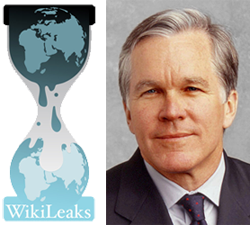 During a wide-ranging conversation on government secrecy and the relationship between The New York Times and WikiLeaks, Times executive editor Bill Keller was asked whether he’d be bothered if WikiLeaks founder Julian Assange were charged under the Espionage Act, as Senator Joe Lieberman recently suggested.
“Let me back into that question,” he said. “I don’t regard Julian Assange as a kindred spirit. If he’s a journalist, he’s not the kind of journalist that I am.“
He said, though, that in some ways WikiLeaks has shifted in the direction of traditional journalism and away from the style of its earlier publications, which were largely just data, unredacted and without comment.
“They have moved to becoming an organization that is leaking out the documents in a more journalistic fashion,” he said. “I don’t think they’ve become my kind of news organization, but they have evolved.”
Keller spoke at the Nieman Foundation’s one-day conference on secrecy and journalism Thursday, where WikiLeaks was a common topic of discussion.
Whatever reservations Keller has about Assange-as-journalist, The New York Times has been at the forefront of getting the organization’s materials to the public — as well as helping shape, at times indirectly, WikiLeaks’ own editorial policies even as the Times worked to decide which materials it would publish of the hundreds of thousands of available documents.
Keller took on critics of the Times’ publication of WikiLeaks’ documents, saying their critiques generally fell into three broad categories:
But despite differences between the newspaper and the organization, Keller said that the paper still provided leadership for the international press on how to handle the material and the organization providing it. He said that “in most cases” the international papers, such as Der Spiegel and the Guardian, followed The New York Times’ guidance and what materials to release or not to release, occasionally differing on materials of particular interest to a certain country (such as the Merkel cables with the Germany’s Der Spiegel). WikiLeaks itself has also followed many of the Times’ suggested redactions.
“Wikileaks, having been castigated for the first two rounds of document dumps, basically said that this time around they would take the redactions we gave them,” Keller said.
Keller also detailed the process by which The New York Times vetted and processed the vast amounts of information, saying that the Times and other news organizations had now finished publishing all the major stories based on the documents they expected to write.
“We then basically agreed on a schedule where day one would be Pakistan day and day two would be Russia day, something like that,” Keller said. “We rolled out on that schedule, and we agreed to give WikiLeaks the documents we intended to publish on each day’s stories, with our redactions.”
Throughout it all, however, Keller said the Times kept a very clear view of what WikiLeaks was and was not in its reporting. “What I have said from the very beginning of this is WikiLeaks is a source, not a partner. The Guardian was kind of a partner in this, because we swapped data and thoughts back and forth saying, ‘Hey, look at this table.’ There was none of that back and forth with WikiLeaks.”