
Journalism Online’s charging clients a 20% commission

If you’ve been following our coverage of Journalism Online, the pay-for-news venture founded by Steve Brill, Gordon Crovitz, and Leo Hindery, you know how they plan to generate revenue for news sites. What hasn’t been clear is how the firm itself will make money.

But in a document submitted to the Newspaper Association of America, which was just made public, Journalism Online reveals its business model: They’re asking for a 20-percent cut of subscription revenue (after credit card fees).

I checked with Cindy Rosenthal, the firm’s spokeswoman, who confirmed the information and said they weren’t charging clients anything beyond the commission. Journalism Online says it has signed letters of intent with media companies representing 176 dailies but won’t disclose their names. Guardian News and Media and The Milwaukee Journal-Sentinel are the only known clients, and most major newspaper companies have said they aren’t on board.

[UPDATE: 10:36 a.m.: In a brief chat with Brill as I waited for the bus this morning, he said, "What we tell publishers is, we only do well if you do well."]

Journalism Online had been the highest-profile of several firms known to be shopping paid-content solutions to news sites. But yesterday we revealed that Google is also making a play in that area, and much of the ensuing coverage suggested a new, if wildly imbalanced, rivalry between Google and Journalism Online. That will depend on how serious Google’s intentions are.

The basic pitch from Journalism Online involves news sites signing up 10 percent of their monthly visitors for some kind of subscription plan. (That figure has been floating between 5 and 15 percent.) But lots of content would remain free so news sites could continue to reap advertising revenue from non-paying visitors. Net profit, in Journalism Online’s models, emerges from subscription revenue, a slight increase in print circulation, and cost savings.

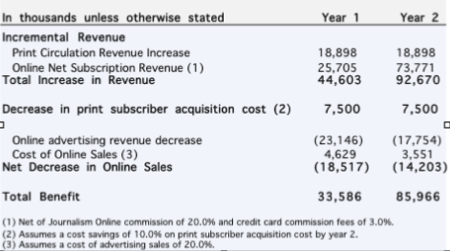
We’ve been through those models before, but the new document that Brill and his colleagues submitted to the NAA includes, for the first time, a model with all of their math in one place, including their commission and an abbreviated balance sheet. So for those following this really closely, here you go:

Below is an excerpt from the business models we have presented to five different-sized newspapers in five different markets based on assumption related to the options outlined above.

Print circulation of 1,000,000.
Total home delivery paper subscribers of 800,000.
Monthly online unique visitors of 20 million.
Annual online subscription price of $75.00 and month-to-month price of $7.50.
Micropayments per article of $0.25 with a total of 6 per subscriber per month.
Online advertising revenue of $175 million per year.
Print circulation revenue of $600 million per year.
Print subscriber retention and acquisition cost of $75 million per year.

Bottom Line Benefit:
$33.6 million in Year One; $86.0 million in Year Two

Assumptions:

  • Assumes a significant amount of continued free access, but with selected content offered to the most engaged online users on a paid basis. This approach optimizes advertising inventory alongside high-margin subscription revenues.
  • 10% of monthly uniques subscribe within two years.
  • Subscriber conversion breakdown assumes 47.5% annual, 47.5% month-to-month and 5.0% micro payment.
  • Total online subscribers of 2.2 million subscribers in year 2, counting people who buy annual or monthly subscriptions or a single article through micropayment.
  • Assumes a 90% subscription renewal rate.
  • Overall page views decrease by 12% at the end of year 2.
  • A 15% decrease in non-subscriber page views is offset by paying subscribers having 25% more page views per user than non-paying users.
  • A 30% higher CPM for pages viewed by subscribers produces overall online advertising decline of 9%.
  • Cost of sales for advertising is 20%.
  • Journalism Online commission of 20% of subscription revenues net of credit card fees of 3%.
  • Adding a paid strategy for selected online access, then bundling online and print subscriptions (offering a “discount” for those who buy both) yields a 3% increase over two years in print subscription circulation revenue.
You can download the 12-page document that Journalism Online submitted to the NAA or view it below (click in the top-right corner for full screen).

Zachary M. Seward | Sept. 10, 2009 | 8:37 a.m.

Tags: , , , , , , , , , , ,


16 comments:

  1. Matt Terenzio at 9:26 am, September 10, 2009

    So a newspaper should expect a greater than 20% gain in online subscriptions by using Journalism Online system of payment over Pay-Pal, Google Checkout or their own circulation system. I don’t see that happening.

     
  2. Mike Orren at 10:42 am, September 10, 2009

    “Micropayments per article of $0.25 with a total of 6 per subscriber per month.”

    Yeah. Best of luck with that.

     
  3. Jeff Sonderman at 12:37 pm, September 10, 2009

    I am highly skeptical that they could force 10% of uniques to subscribe while only losing 12% of traffic over two years.

    I doubt they can support the likelihood of that.

     
  4. enhager at 12:49 pm, September 10, 2009

    $75!!! What site now charges $75? And assuming that 10 percent of your online monthly uniques will subscribe (2 million for the first example) – that would double your print circulation (which is tied to your geographic location, unlike your web hits).

    This model has no foundation in reality I know of.

     
  5. ric at 4:30 pm, September 10, 2009

    This is absurd on many levels least of which are the profound changes in the way that consumers value news. When we needed to have someone filter our news so we would know what we were getting all these old media models made sense. But now when any Joe off the street can be a thought leader and often is and news is tractable in real time .. the models no longer work. You guys better start carving your niche or find another gig.

     
  6. Mike Donatello at 6:39 pm, September 10, 2009

    Okay, guys, that was funny. Really was. Now show us the real plan.

    Look at a few of the assumptions:

    - 20MM online UV monthly?
    - 30% higher CPM for pages viewed by subscribers?
    - 90% subscription renewal rate at $75 a year?

    As my grandpa said, you know what happens when you assume. Any publisher who swallows this pill deserves the ugly result.

     
  7. Tim Barrett at 2:10 am, September 11, 2009

    From what I know about this business, which isn’t much, the cost of putting a paper edition on the streets is about 50% of the operation.
    Quit printing the damned paper!
    There’s a whole new generation coming of age that wants nothing to do with newspapers and this business model is making a very naive assumption regarding future circulation numbers. The newspaper is going the way of the console stereo. Concentrate on the Internet and quit trying to do both.
    Let the trees do what trees do. The planet and everyone on it will thank you.

     
  8. Mike Mokrzycki at 11:22 am, September 12, 2009

    A little late to this party, but … I really would like to see the empirical basis for these assumptions. In the Research and Data Analysis section the JournalismOnline document for NAA says only: “This has been discussed at length with NAA members and because it relates to pricing and other strategies we do not feel it appropriate to share it in this context.”

    I suppose JO might feel it has no disclosure obligation to anyone but its potential customers but it could inspire broader confidence by divulging at least a basic outline of what research was conducted on consumer willingness to pay for online news. See the NY Times Co.’s Insight Lab for a model of far greater openness in this regard.

    Without such disclosure the JO pitch is too easily dismissed as highly wishful thinking. Read the eight quotes at “Why Readers Will Pay For Online News” at http://www.journalismonline.com/quotes.php . Seven are about why publishers should charge for online news. One is an eloquent statement by David Corn on why readers *should* pay for online news. Nothing on that page addresses why readers supposedly *will* pay for online news.

     
  9. Nico Flores at 9:05 am, September 30, 2009

    Has anybody tried to follow the math? If you accept the assumptions, in year 2 you have 2.2 million online subscribers, each paying circa $75 pa. So you should get get around $150m revenue gross, or $116m after fees (a bit more if you follow the details).

    However, in the published excerpt they predict $73.77m net revenue from online subs for year 2. That is, the prediction seems to be short by around 60%.

    Thanks for any thoughts.


Trackbacks:

  1. Doing the Math on Paid Newspaper Content - Media Decoder Blog - NYTimes.com at 9:59 am, September 10, 2009

    [...] Lab has been following the paid content story very closely and is reporting that the model for Journalism Online, the company formed by Steve Brill, Gordon Crovitz, and Leo Hindery, will make money by taking a 20 [...]

     
  2. Details on Journalism Online’s pay plan « InfoMash at 11:19 am, September 10, 2009

    [...] per month or $75 per year (earlier estimates were $50-60 per year). The details available at the Nieman Foundation’s blog are unclear, but I assume that the $.25 micropayment charge is for non-subscribers who want to [...]

     
  3. Digital Paperboy « Barataria – the work of Erik Hare at 10:23 pm, September 10, 2009

    [...] best information we have yet comes from the Neiman Journalism Lab, and the 12 page document is available.  The model is still under development, so we can’t say [...]

     
  4. Journalism Online paid content venture to take 20 per cent commission | Journalism.co.uk Editors' Blog at 4:29 am, September 11, 2009

    [...] Nieman Journalism Lab reports that the company will take a 20 per cent cut of subscription revenue (after credit card fees). [...]

     
  5. The Home of the Not-So-Free « 78 Picas at 2:04 pm, September 11, 2009

    [...] Several unnamed papers have signed with Journalism Online to help them come up with a plan to charge for content. (Also in the news, Journalism Online will be charging a 20 percent commission for new subscribers.) [...]

     
  6. Innovar es hacer lo mismo, pero mejor. | La Empresa de los Contenidos Digitales at 5:26 am, September 21, 2009

    [...] de impresión de libros bajo demanda o la venta de artículos con micropagos (tal y como proponen JournalismOline o Google). Si una constante hay en todas estas fórmulas es que no estamos inventando nada [...]

     
  7. How Steve Brill has adjusted his pay-for-news pitch » Nieman Journalism Lab at 3:01 pm, November 20, 2009

    [...] on at least some of its 1,200 affiliates pulling the trigger: Journalism Online is taking a 20% cut of subscription revenue. AKPC_IDS += [...]


Leave a comment

Check out these related posts