
Nieman Foundation at Harvard


From direct mail to web design, A/B testing is considered a gold standard of user research: Show one version to half your audience and another version to the other half; compare results, and adjust accordingly. Some very cool examples include Google’s obsessive testing of subtle design tweaks and Dustin Curtis’ experiment with direct commands and clickthrough rates. (“You should follow me on Twitter” produced dramatically better results than the less moralizing, “Follow me on Twitter.”)
So here’s something devilishly brilliant: The Huffington Post applies A/B testing to some of its headlines. Readers are randomly shown one of two headlines for the same story. After five minutes, which is enough time for such a high-traffic site, the version with the most clicks becomes the wood that everyone sees.
Headlines have always played the most promotional role in news, charged with selling readers on the articles they adorn, so it only makes sense to apply the best tools of market research to their crafting. Think of it as a more rigorous version of magazines adjusting their covers based on newsstand sales.
Paul Berry, chief technology officer at The Huffington Post, spoke briefly about their real-time headline testing on a panel at the Online News Association conference in San Francisco earlier this month. When I talked to him afterwards, Berry said the system was created inhouse, but he wouldn’t disclose much else about how or how often it’s done. He did say Huffington Post editors have found that placing the author’s name above a headline almost always leads to more clicks than omitting it.
Though it’s unrelated to this A/B testing, The Huffington Post’s new social media editor, Josh Young, has also been soliciting better headlines from readers on Twitter. That’s not as awesomely scientific, but it’s a pretty good use of the crowd.
Studying and responding to users was the theme of Berry’s panel, which also included Steve Dorsey, who conducts qualitative research on reader behavior for the Detroit Free Press, and Eric Brown, homepage planning editor for Yahoo.
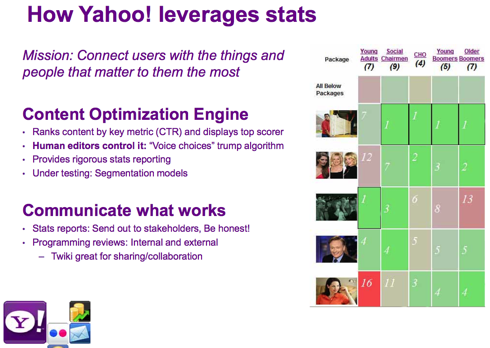
Brown said Yahoo closely tracks clickthroughs to measure which content does well with which audiences, as illustrated in his slide below. Yahoo may eventually use that data to serve, say, teenage girls a different version of the front page than they serve to middle-aged men. (Brown’s entire presentation from ONA is here.)
On the topic of audience segmentation, Berry told me that The Huffington Post is considering separate East Coast and West Coast editions. He used the example of morning-after Oscars coverage, when readers flock to slideshows and blog posts about the event. But the story is old news to East Coast readers by noon, when the West Coast is only first logging on, so it would make sense to serve New Yorkers fresher headlines while Californians get their Oscars fix. Identifying readers’ location from their IP address is easy, but coordinating different editions of the site would be a challenge.